sábado, 8 de septiembre de 2018

What you need to know ahead of the EU copyright vote

European Union lawmakers are facing a major vote on digital copyright reform proposals on Wednesday — a process that has set the Internet’s hair fully on fire.

Here’s a run down of the issues and what’s at stake…

Article 13

The most controversial component of the proposals concerns user-generated content platforms such as YouTube, and the idea they should be made liable for copyright infringements committed by their users — instead of the current regime of takedowns after the fact (which locks rights holders into having to constantly monitor and report violations — y’know, at the same time as Alphabet’s ad business continues to roll around in dollars and eyeballs).
Critics of the proposal argue that shifting the burden of rights liability onto platforms will flip them from champions to chillers of free speech, making them reconfigure their systems to accommodate the new level of business risk.

More specifically they suggest it will encourage platforms into algorithmically pre-filtering all user uploads — aka #censorshipmachines — and then blinkered AIs will end up blocking fair use content, cool satire, funny memes etc etc, and the free Internet as we know it will cease to exist.

Backers of the proposal see it differently, of course. These people tend to be creatives whose professional existence depends upon being paid for the sharable content they create, such as musicians, authors, filmmakers and so on.

Their counter argument is that, as it stands, their hard work is being ripped off because they are not being fairly recompensed for it.

Consumers may be the ones technically freeloading by uploading and consuming others’ works without paying to do so but creative industries point out it’s the tech giants that are gaining the most money from this exploitation of the current rights rules — because they’re the only ones making really fat profits off of other people’s acts of expression. (Alphabet, Google’s ad giant parent, made $31.16BN in revenue in Q1 this year alone, for example.)

YouTube has been a prime target for musicians’ ire — who contend that the royalties the company pays them for streaming their content are simply not fair recompense.

Article 11

The second controversy attached to the copyright reform concerns the use of snippets of news content.

European lawmakers want to extend digital copyright to also cover the ledes of news stories which aggregators such as Google News typically ingest and display — because, again, the likes of Alphabet is profiting off of bits of others’ professional work without paying them to do so. And, on the flip side, media firms have seen their profits hammered by the Internet serving up free content.

The reforms would seek to compensate publishers for their investment in journalism by letting them charge for use of these text snippets — instead of only being ‘paid’ in traffic (i.e. by becoming yet more eyeball fodder in Alphabet’s aggregators).
Critics don’t see it that way of course. They see it as an imposition on digital sharing — branding the proposal a “link tax” and arguing it will have a wider chilling effect of interfering with the sharing of hyperlinks.

They argue that because links can also contain words of the content being linked to. And much debate has raged over on how the law would (or could) define what is and isn’t a protected text snippet.

They also claim the auxiliary copyright idea hasn’t worked where it’s already been tried (in Germany and Spain). Google just closed its News aggregator in the latter market, for example. Though at the pan-EU level it would have to at least pause before taking a unilateral decision to shutter an entire product.

Germany’s influential media industry is a major force behind Article 11. But in Germany a local version of a snippet law that was passed in 2013 ended up being watered down — so news aggregators were not forced to pay for using snippets, as had originally been floated.

Without mandatory payment (as is the case in Spain) the law has essentially pitted publishers against each other. This is because Google said it would not pay and also changed how it indexes content for Google News in Germany to make it opt-in only.

That means any local publishers that don’t agree to zero-license their snippets to Google risk losing visibility to rivals that do. So major German publishers have continued to hand their snippets over to Google.

But they appear to believe a pan-EU law might manage to tip the balance of power. Hence Article 11.

Awful amounts of screaming

For critics of the reforms, who often sit on the nerdier side of the spectrum, their reaction can be summed up by a screamed refrain that IT’S THE END OF THE FREE WEB AS WE KNOW IT.

WikiMedia has warned that the reform threatens the “vibrant free web”.

A coalition of original Internet architects, computer scientists, academics and others — including the likes of world wide web creator Sir Tim Berners-Lee, security veteran Bruce Schneier, Google chief evangelist Vint Cerf, Wikipedia founder Jimmy Wales and entrepreneur Mitch Kapor — also penned an open letter to the European Parliament’s president to oppose Article 13.

In it they wrote that while “well-intended” the push towards automatic pre-filtering of users uploads “takes an unprecedented step towards the transformation of the Internet from an open platform for sharing and innovation, into a tool for the automated surveillance and control of its users”.

There is more than a little irony there, though, given that (for example) Google’s ad business conducts automated surveillance of the users of its various platforms for ad targeting purposes — and through that process it’s hoping to control the buying behavior of the individuals it tracks.

At the same time as so much sound and fury has been directed at attacking the copyright reform plans, another very irate, very motivated group of people have been lustily bellowing that content creators need paying for all the free lunches that tech giants (and others) have been helping themselves to.

But the death of memes! The end of fair digital use! The demise of online satire! The smothering of Internet expression! Hideously crushed and disfigured under the jackboot of the EU’s evil Filternet!

And so on and on it has gone.

(For just one e.g., see the below video — which was actually made by an Australian satirical film and media company that usually spends its time spoofing its own government’s initiatives but evidently saw richly viral pickings here… )

For a counter example, to set against the less than nuanced yet highly sharable satire-as-hyperbole on show in that video, is the Society of Authors — which has written a 12-point breakdown defending the actual substance of the reform (at least as it sees it).

A topline point to make right off the bat is it’s hardly a fair fight to set words against a virally sharable satirical video fronted by a young lady sporting very pink lipstick. But, nonetheless, debunk the denouncers these authors valiantly attempt to.

To wit: They reject claims the reforms will kill hyperlinking or knife sharing in the back; or do for online encyclopedias like Wikimedia; or make snuff out of memes; or strangle free expression — pointing out that explicit exceptions that have been written in to qualify what it would (and would not) target and how it’s intended to operate in practice.

Wikipedia, for example, has been explicitly stated as being excluded from the proposals.

But they are still pushing water uphill — against the tsunami of DEATH OF THE MEMES memes pouring the other way.

Russian state propaganda mouthpiece RT has even joined in the fun, because of course Putin is no fan of EU…

Terrible amounts of lobbying

The Society of Authors makes the very pertinent point that tech giants have spent millions lobbying against the reforms. They also argue this campaign has been characterised by “a loop of misinformation and scaremongering”.

So, basically, Google et al stand accused of spreading (even more) fake news with a self-interested flavor. Who’d have thunk it?!
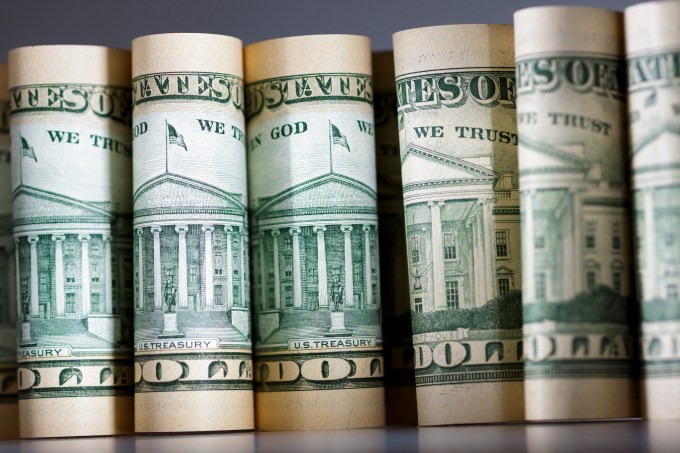
Dollar bills standing on a table in Berlin, Germany. (Photo by Thomas Trutschel/Photothek via Getty Images)

The EU’s (voluntary) Transparency Register records Google directly spending between $6M and $6.4M on regional lobbying activities in 2016 alone. (Although that covers not just copyright related lobbying but a full laundry list of “fields of interest” its team of 14 smooth-talking staffers apply their Little Fingers to.)

But the company also seeks to exert influence on EU political opinion via membership of additional lobbying organizations.

And the register lists a full TWENTY-FOUR organizations that Google is therefore also speaking through (by contrast, Facebook is merely a member of eleven bodies) — from the American chamber of Commerce to the EU to dry-sounding thinktanks, such as the Center for European Policy Studies and the European Policy Center. It is also embedded in startup associations, like Allied for Startups. And various startup angles have been argued by critics of the copyright reforms — claiming Europe is going to saddle local entrepreneurs with extra bureaucracy.

Google’s dense web of presence across tech policy influencers and associations amplifies the company’s regional lobbying spend to as much as $36M, music industry bosses contend.

Though again that dollar value would be spread across multiple GOOG interests — so it’s hard to sum the specific copyright lobbying bill. (We asked Google — it didn’t answer). Multiple millions looks undeniable though.

Of course the music industry and publishers have been lobbying too.

But probably not at such a high dollar value. Though Europe’s creative industries have the local contacts and cultural connections to bend EU politicians’ ears. (As, well, they probably should.)

Seasoned European commissioners have professed themselves astonished at the level of lobbying — and that really is saying something.

Yes there are actually two sides to consider…
Returning to the Society of Authors, here’s the bottom third of their points — which focus on countering the copyright reform critics’ counterarguments:

The proposals aren’t censorship: that’s the very opposite of what most journalists, authors, photographers, film-makers and many other creators devote their lives to.

Not allowing creators to make a living from their work is the real threat to freedom of expression.

Not allowing creators to make a living from their work is the real threat to the free flow of information online.

Not allowing creators to make a living from their work is the real threat to everyone’s digital creativity.

Stopping the directive would be a victory for multinational internet giants at the expense of all those who make, enjoy and enjoy using creative works.

Certainly some food for thought there.

But as entrenched, opposing positions go, it’s hard to find two more perfect examples.

And with such violently opposed and motivated interest groups attached to the copyright reform issue there hasn’t really been much in the way of considered debate or nuanced consideration on show publicly.

But being exposed to endless DEATH OF THE INTERNET memes does tend to have that effect.

What’s that about Article 3 and AI?

There is also debate about Article 3 of the copyright reform plan — which concerns text and data-mining. (Or TDM as the Commission sexily conflates it.)

The original TDM proposal, which was rejected by MEPs, would have limited data mining to research organisations for the purposes of scientific research (though Member States would have been able to choose to allow other groups if they wished).

This portion of the reforms has attracted less attention (butm again, it’s difficult to be heard above screams about dead memes). Though there have been concerns raised from certain quarters that it could impact startup innovation — by throwing up barriers to training and developing AIs by putting rights blocks around (otherwise public) data-sets that could (otherwise) be ingested and used to foster algorithms.

Or that “without an effective data mining policy, startups and innovators in Europe will run dry”, as a recent piece of sponsored content inserted into Politico put it.

That paid for content was written by — you guessed it! — Allied for Startups.

Aka the organization that counts Google as a member…

The most fervent critics of the copyright reform proposals — i.e. those who would prefer to see a pro-Internet-freedoms overhaul of digital copyright rules — support a ‘right to read is the right to mine’ style approach on this front.

So basically a free for all — to turn almost any data into algorithmic insights. (Presumably these folks would agree with this kind of thing.)

Middle ground positions which are among the potential amendments now being considered by MEPs would support some free text and data mining — but, where legal restrictions exist, then there would be licenses allowing for extractions and reproductions.


And now the amendments, all 252 of them…

The whole charged copyright saga has delivered one bit of political drama already —  when the European Parliament voted in July to block proposals agreed only by the legal affairs committee, thereby reopening the text for amendments and fresh votes.

So MEPs now have the chance to refine the parliament’s position via supporting select amendments — with that vote taking place next week.

And boy have the amendments flooded in.

There are 252 in all! Which just goes to show how gloriously messy the democratic process is.

It also suggests the copyright reform could get entirely stuck — if parliamentarians can’t agree on a compromise position which can then be put to the European Council and go on to secure final pan-EU agreement.

MEP Julia Reda, a member of The Greens–European Free Alliance, who as (also) a Pirate Party member is very firmly opposed to the copyright reform text as was voted in July (she wants a pro-web-freedoms overhauling of digital copyright rules), has created this breakdown of alternative options tabled by MEPs — seen through her lens of promoting Internet freedoms over rights extensions.

So, for example, she argues that amendments to add limited exceptions for platform liability would still constitute “upload filters” (and therefore “censorship machines”).

Her preference would be deleting the article entirely and making no change to the current law. (Albeit that’s not likely to be a majority position, given how many MEPs backed the original Juri text of the copyright reform proposals 278 voted in favor, losing out to 318 against.)

But she concedes that limiting the scope of liability to only music and video hosting platforms would be “a step in the right direction, saving a lot of other platforms (forums, public chats, source code repositories, etc.) from negative consequences”.

She also flags an interesting suggestion — via another tabled amendment — of “outsourcing” the inspection of published content to rightholders via an API”.

“With a fair process in place [it] is an interesting idea, and certainly much better than general liability. However, it would still be challenging for startups to implement,” she adds.

Reda has also tabled a series of additional amendments to try to roll back what she characterizes as “some bad decisions narrowly made by the Legal Affairs Committee” — including adding a copyright exception for user generated content (which would essentially get platforms off the hook insofar as rights infringements by web users are concerned); adding an exception for freedom of panorama (aka the taking and sharing of photos in public places, which is currently not allowed in all EU Member States); and another removing a proposed extra copyright added by the Juri committee to cover sports events — which she contends would “filter fan culture away“.

So is the free Internet about to end??

MEP Catherine Stihler, a member of the Progressive Alliance of Socialists and Democrats, who also voted in July to reopen debate over the reforms reckons nearly every parliamentary group is split — ergo the vote is hard to call.

“It is going to be an interesting vote,” she tells TechCrunch. “We will see if any possible compromise at the last minute can be reached but in the end parliament will decide which direction the future of not just copyright but how EU citizens will use the internet and their rights on-line.

“Make no mistake, this vote affects each one of us. I do hope that balance will be struck and EU citizens fundamental rights protected.”

So that sort of sounds like a ‘maybe the Internet as you know it will change’ then.

Other views are available, though, depending on the MEP you ask.

We reached out to Axel Voss, who led the copyright reform process for the Juri committee, and is a big proponent of Article 13, Article 11 (and the rest), to ask if he sees value in the debate having been reopened rather than fast-tracked into EU law — to have a chance for parliamentarians to achieve a more balanced compromise. At the time of writing Voss hadn’t responded.

Voting to reopen the debate in July, Stihler argued there are “real concerns” about the impact of Article 13 on freedom of expression, as well as flagging the degree of consumer concern parliamentarians had been seeing over the issue (doubtless helped by all those memes + petitions), adding: “We owe it to the experts, stakeholders and citizens to give this directive the full debate necessary to achieve broad support.”

MEP Marietje Schaake, a member of the Alliance of Liberals and Democrats for Europe, was willing to hazard a politician’s prediction that the proposals will be improved via the democratic process — albeit, what would constitute an improvement here of course depends on which side of the argument you stand.

But she’s routing for exceptions for user generated content and additional refinements to the three debated articles to narrow their scope.

Her spokesman told us: “I think we’ll end up with new exceptions on user generated content and freedom of panorama, as well as better wording for article 3 on text and data mining. We’ll end up probably with better versions of articles 11 and 13, the extent of the improvement will depend on the final vote.”

The vote will be held during an afternoon plenary session on September 12.

So yes there’s still time to call your MEP.


from TechCrunch https://ift.tt/2wUgRL6
via IFTTT

miércoles, 5 de septiembre de 2018

Cyan Banister shares her journey from homeless teen to VC

This morning at TechCrunch SF 2018, Founders Fund partner Cyan Banister shared her inspirational journey from a homeless teen at the age of 15 to now a venture capitalist who’s invested in startups like Uber, Thumbtack, SpaceX, Postmates, EShares, Affirm and Niantic.

Banister spoke this morning at Disrupt about the handful of values she cites as key to making the transition from the streets to VC investing. These included incrementalism — meaning focusing on the next step, whether that’s getting the next meal or shower, for example — as well as individualism, mentorship and technology, and endless curiosity.

She credits being obsessed with making more money — capitalism — as being what eventually saved her life. She was always focused on getting to the next step — getting that next meal, getting a shower, getting a job, then learning new skills.

Banister began to see all this as a game, and each step was a form of “leveling up.”

Getting insight and advice from tech mentors she encountered was another turning point in her life, Banister says.

Learning to use computers, get online and, eventually, write code gave her access to the internet, hacker culture and then, entry-level tech work.

“Suddenly, my brain was fully engaged for the first time in my life,” she says.

By taking initiative at work in unconventional ways, she was fortunate to not be fired for not following the rules, but rather encouraged to explore her creativity. She received a promotion that allowed her to learn about Linux, BSD, how the internet actually works and how to set up routers DNS servers email servers over the next two years.

And she did all this as a high school dropout who never went to college.

After moving to San Francisco and working at a startup, Banister earned a windfall after an exit to Cisco. This, she used to make investments in other up-and-coming tech companies.

“My first angel check went into SpaceX. I was terrified but it was exciting… I became addicted,” she says.

Her savvy investments got her an invite to join Founders Fund, as a partner.

“I have a chance to play in a new arena and stretch myself intellectually,” Banister says.

When asked how she did it, she responded, “I can only tell you that I was endlessly curious. I surrounded myself with people smarter and more capable than me. I played the game every day, I still do.”


from TechCrunch https://ift.tt/2Ck6B4E
via IFTTT

Airbnb for Work is getting bigger

Experiences, not cash, are the new corporate bonus. At least, according to Airbnb.

With that mantra in mind, the $31 billion company is expanding the part of its business that targets business travelers, called Airbnb for Work. The new effort will help them tap into a large market they’ve been missing out on—non-travelers.

Airbnb is adding three new features. The first addition allows businesses to use Airbnb Experiences, the part of the app or website where travelers can book tours or events for their vacations, to arrange team-building activities, like sailing lessons or pastry-making classes. The second makes some of the homes available on Airbnb for corporate off-sites and meetings. And the final new feature lets employers secure temporary housing for employees relocating for work.

“In today’s hyper-competitive talent environment, once you’ve recruited great employees, you want to keep them,” the company wrote in today’s announcement“The spaces where people spend time away from the office make a big difference. Sterile conference rooms aren’t motivating and don’t foster creativity. However, relaxing and productive environments help people open up to connect and contribute; they help teams achieve their shared goals more effectively.”

Airbnb for Work has proven to be quite the money-making endeavor since its 2014 launch as “Airbnb for Business,” and now accounts for 15% of its bookings. It saw 3x growth in bookings from 2015 to 2016 and again from 2016 to 2017. 700,000 companies have used the service to plan business travel.

Airbnb has been busy expanding its platform this year. Last month, it integrated Airbnb listings into Concur’s search and booking tool in what was the first time it linked up with a corporate travel platform. A few months before that, it established a new tier specifically for high-end customers called Airbnb Plus and Beyond by Airbnb.

The hospitality powerhouse is expected to hit the public markets as soon as June 30, 2019. Slowly, it’s taking the steps necessary to IPO, like creating a bonus program that will provide cash bonuses to employees in 2018 and 2019 and poaching an Amazon executive to lead its homes unit.


from TechCrunch https://ift.tt/2LU9A3v
via IFTTT

EU to move ahead with cultural quotas for streaming services

The European Union is set to move ahead with a plan to enforce pan-European quotas on streaming services like Amazon Prime Video and Netflix to support production of locally produced film and video content.

Roberto Viola, the European Commission’s directorate general of communication, networks, content and technology told Variety that the new rules are on track to be approved in December.

“We just need the final vote, but it’s a mere formality,” he said in an interview at the Venice Film Festival.

The proposals will require that streaming services give over at least 30% of their on-demand catalogues to original productions made in each EU country where a service is provided (individual EU Member States could choose to set the content bar even higher, at 40%).

Streaming services will also have to ensure visibility and prominence for local content — so no burying the ‘European third’ in a dingy corner of the site where no one will find it, let alone stream it.

The EU lawmakers’ intention is to stand up for cultural diversity against the might of Hollywood and the flattening power of platforms — in the latter case by making platforms invest in local content production rather than just doing the easy thing of fencing yet more Marvel superhero movies.

And, frankly, if you’ve seen one superhero movie you’ve seen them all. So the move — which will probably draw loud and hair-raising screams from U.S. commentators — is, nonetheless, A Good Thing.

It is also not at all unusual in Europe, where cultural diversity is championed and measures to protect linguistic and cultural difference are not just acceptable but the welcome norm.

On the film front, some EU countries already require cinemas screen a portion of locally content, for example.

The Commission’s revision to EU audiovisual law will go further, by bolstering local content production across the region, including by placing requirements on local broadcasters to reserve a majority of airtime for European content. And also by requiring that streaming services actively promote EU works.

Hollywood + platform power is now a force so very mighty that cultural difference risks being steamrollered before it until nothing but tedious superhero tropes remain.

At least without proactive policy counteractions to unlock investments in creativity at a local level and not just protect but develop community voices. Ergo, the real superhero is a policy that battles the evil of cultural homogeneity and champions local light and color.

In Germany, which has already pushed ahead with content quotas on streaming services, a surcharge is added to subscription fees for the services to support a national production fund.

Netflix attempted to challenge the Commission’s support of Germany’s move to support its local film industry in the courts, arguing it countered EU law on state aid.

But in May the European General Court dismissed its appeal against the EC decision — saying its action was inadmissible as Netflix has no legal standing to challenge the decision.

We’ve reached out to Amazon and Netflix for comment on Viola’s comments.

Image credit: Trailer still from Blue is the Warmest Colour


from TechCrunch https://ift.tt/2NQkzNb
via IFTTT

martes, 4 de septiembre de 2018

Netflix snags former Disney exec Christie Fleischer to lead its consumer products team

Netflix is doubling down on its merchandising efforts with its hiring of former Disney exec Christie Fleischer to head its global Consumer Products team. Previously the head of merchandise for parks, experiences and consumer products at Disney, Fleischer will now lead a team at Netflix focused on overseeing retail and licensee partnerships, publishing, interactive games, merchandising and experiential events, the company says.

This role will include developing consumer products across all categories for Netflix original series and films.

Merchandise is an area Netflix has dabbled in before – like those “Stranger Things” tees at Target and other items at Hot Topic, for example  – but not at scale. However, the company today has a number of original series and films where merchandising and other products make sense. This includes not only more mainstream fare like “Stranger Things,” but also originals aimed at kids where toys and games could be the next step in connecting with fans.

Netflix’s plan to push into merchandise has been known for some time.

Bloomberg reported last year that the company had posted a job opening for a “licensing, merchandising and promotion” senior manager who would pursue consumer products in order to “drive meaningful show awareness.”

The job description referenced merchandise like books, comics, gaming, toys, collectibles, soundtracks and apparel.

Fleischer’s background at Disney makes her a good fit for the role. Before working as head of merchandise, she was the Senior Vice President of retail & merchandise for Parks & Resorts, where she oversaw merchandise product strategy, product development, planning, visual merchandising, store design, supply chain and logistics.

She also worked in merchandise management for Warnaco Inc, American Pacific Enterprises and The Disney Store.

The hire is also notable as Disney is planning its own Netflix-like service, launching in 2019 – making the two companies even more of direct competitors than they were before. And this isn’t the first time Netflix has siphoned off Disney talent for itself – it also just landed top Disney production exec Tendo Nagenda last month.

Licensed merchandise could be a multi-million dollar – or even billion dollar – business for Netflix, if all goes well. As Statista noted last fall, the top 10 merchandise licensors are each pulling in billions in this market, led by Disney – which makes around $57 billion thanks to big-name franchises like “Star Wars,” “Frozen,” and others.

Netflix doesn’t have its own “Star Wars,” but it does have 130 million paying customers worldwide, most of whom watch several of its original series and movies. That’s a good start.

“Christie brings a wealth of experience and creativity from the consumer products world. She has helped to build some of the world’s most beloved brands and we’re thrilled that she will join us to give our fans more opportunities to interact with Netflix in new and exciting ways,” said Kelly Bennett, Chief Marketing Officer, in a statement about the new hire. “We want to create the highest quality experience for our fans in everything we do.”

Fleischer begins work in L.A., starting today.


from TechCrunch https://ift.tt/2PAv7AA
via IFTTT

Wikimedia warns EU copyright reform threatens the ‘vibrant free web’

The Wikimedia Foundation has sounded a stark warning against a copyright reform proposal in Europe that’s due to be voted on by the European Parliament next week. (With the mild irony that it’s done so with a blog post on the commercial Medium platform.)

In the post, also emailed to TechCrunch, María Sefidari Huici, chair of the Wikimedia Foundation, writes: “Next week, the European Parliament will decide how information online is shared in a vote that will significantly affect how we interact in our increasingly connected, digital world. We are in the last few moments of what could be our last opportunity to define what the Internet looks like in the future.

“The next wave of proposed rules under consideration by the European Parliament will either permit more innovation and growth, or stifle the vibrant free web that has allowed creativity, innovation, and collaboration to thrive. This is significant because copyright does not only affect books and music, it profoundly shapes how people communicate and create on the internet for years to come.”

Backers of the reform proposals argue they will help European creatives be fairly recompensed for their work. But critics argue the proposals are not balanced and will chill the creative freedoms of web users to share and comment on content online.

The two articles attracting the most controversy in the reforms are:

  • Article 11; which proposes a neighboring copyright for snippets of journalistic content — requiring news aggregators such as Google News to gain a license from the publisher to use this type of content (branded a ‘link tax’ by critics);
  • Article 13; which seeks to shift liability for platform users’ copyright infringements onto the platforms themselves — and which critics contend will therefore push them towards creating upload filters to monitor all content before it’s posted, having a chilling effect on Internet expression. Critics sometimes dub this component ‘censorship machines’.

In July MEPs issued a smackdown to the Commission by refusing to back the reforms — and voting to reopen debate. Another vote is due next week, with amendments in the process of being tabled now, hence Wikimedia’s intervention.

In her blog post, Sefidari Huici urges MEPs to remember the original objective for the update: “To make copyright rules that work for better access to a quickly-evolving, diverse, and open internet.”

“The very context in which copyright operates has changed completely. Consider Wikipedia, a platform which like much of the internet today, is made possible by people who act as consumers and creators. People read Wikipedia, but they also write and edit articles, take photos for Wikimedia Commons, or contribute to other Wikimedia free knowledge projects. Content on Wikipedia is available under a free license for anyone to use, copy, or remix,” she writes.

“Every month, hundreds of thousands of volunteers make decisions about what content to include on Wikipedia, what constitutes a copyright violation, and when those decisions need to be revised. We like it this way — it allows people, not algorithms, to make decisions about what knowledge should be presented back to the rest of the world.”

She also warns that changes to EU copyright could have serious implications for Wikipedia and other collaborative non-profit websites, urging MEPs to “institute policies that promote the free exchange of information online for everyone”.

“We urge EU representatives to support reform that adds critical protections for public domain works of art, history, and culture, and to limit new exclusive rights to existing works that are already free of copyright,” she writes.

On Article 13 specifically she warns this would push platforms towards creating “costly, often biased systems to automatically review and filter out potential copyright violations on their sites”, warning: “We already know that these systems are historically faulty and often lead to false positives. For example, consider the experience of a German professor who repeatedly received copyright violation notices when using public domain music from Beethoven, Bartók, and Schubert in videos on YouTube.”

“The internet has already created alternative ways to manage these issues,” she adds. “For instance, Wikipedia contributors already work hard to catch and remove infringing content if it does appear. This system, which is largely driven by human efforts, is very effective at preventing copyright infringement.”

She also argues that the copyright reform debate has been dominated by market relationships between large rights holders and for-profit internet platforms — saying this too narrow slice “does not reflect the breadth of websites and users on the internet today”.

“Wikipedians are motivated by a passion for information and a sense of community. We are entirely nonprofit, independent, and volunteer-driven. We urge MEPs to consider the needs of this silent majority online when designing copyright policies that work for the entire internet,” she adds, calling for MEPs to create a copyright framework that reflects “the evolution of how people use the internet today”.

“We must remember the original problem policymakers set out to solve: to bring copyright rules in line with a dramatically larger, more complex digital world and to remove cross-border barriers. We should remain true to the original vision for the internet — to remain an open, accessible space for all.”

Asked for a response to Wikimedia’s criticisms, a spokeswoman for the European Commission pointed us to an FAQ where it discusses what will happen to online encyclopaedias based on content uploaded by users — and claims these sites will not fall under the scope of the reform (because “the vast majority of the content on Wikipedia is uploaded with the consent of their rights holders” — something critics of the reform dispute).

She also sent us a general comment from Commission spokesperson, Nathalie Vandystadt, in which she states:

The new copyright rules are necessary in order to allow creators and the press to get a better deal when their works are made available online. At the same time, our proposal safeguards free speech and ensures that online platforms – including 7,000 European online platforms – can develop new and innovative offers and business models. It will not ban memes or hyperlinks, as has often been claimed in the public debate.

The Commission presented its balanced proposal two years ago, in September 2016. We have discussed the proposal with all relevant actors. We now expect the European Parliament to reach a position and stand ready to start negotiations on this important reform with the Parliament and the Council of the EU as soon as possible. The process has been long enough. Any further delay at this stage would put at risk adoption before the next European elections.

It’s not the first time Wikimedia has made a high profile intervention in the reform debate; Wikipedia founder Jimmy Wales added his name to an open letter in June warning that it “takes an unprecedented step towards the transformation of the Internet from an open platform for sharing and innovation, into a tool for the automated surveillance and control of its users”.

While, in July, several local language versions of the Wikipedia encyclopaedia voted to temporarily black out their content to protest the copyright proposals.

It remains to be seen whether MEPs will be swayed by all this public pressure — not least given all the counterlobbying they are getting behind the scenes.

Commenting on the state of play for the copyright reform ahead of the vote later this month, Marietje Schaake, a Dutch Member of the European Parliament, told us it’s too close to call right now.

“Right now it is impossible to say how the copyright vote will play out next week. I have been working hard on a sensible compromise that respects our fundamental rights, but we don’t know until tomorrow which amendments will be voted on,” she told TechCrunch. “MEPs and political groups are still making up their minds, and the margins are very tight. The votes could swing either way.”

Schaake said it’s likely more clarity will emerge tomorrow, once it’s clear who has tabled what (in terms of amendments) that will then get voted on by the whole parliament next week.

On the controversial article 13 portion of the reform, which would make platforms directly liable for copyright infringements by users, options likely to be on the table include some previous texts (such as the text produced the Commission, or the original Legal Affairs Committee (Juri) text), which are therefore unlikely to gain a majority.

An amendment suggesting full deletion of the article is also likely to be tabled — but also probably wouldn’t get majority backing given the level of backing the reform has behind it.

There may also be a version of the text produced by the Internal Market and Consumer Protection committee, which had joint competency on Article 13 of the proposal with the Juri committee but at the vote in July argued that its position had not been taken into account by the Juri text (which it criticized as not achieving “the needed balance”.

On top of that additional new compromise versions — which “aim to remove the worst parts of Article 13”, as Schaake puts it — are also likely to be tabled. But with votes predicted to be tight it’s hard to say which way MEPs will jump.

In July, the parliament voted by 318 votes to 278, with 31 abstentions, to reject the negotiating mandate that had been proposed by the Juri committee the month before.

As a result, the parliament’s position was reopened for debate, amendment and a vote — which will be held during an afternoon plenary session on September 12.

The EC’s VP and commissioner for the digital single market, Andrus Ansip, has described the scale of lobbying from “all sides” around the copyright reform proposals as “astonishing“.

“Everyone claims that their rivals will kill creativity, or kill innovation, or kill the internet — or kill all of it at the same time. This all has to stop. It is getting us nowhere,” he wrote in a blog post in late July. “It is good to have a lively debate about copyright – but not one which has descended into slogans and exaggeration.

“We need to go beyond that, to find an acceptable and workable compromise that gives Europeans the right kind of copyright laws for the digital age. They deserve nothing less. And it is achievable.”

“Today, the debate sounds as if we had to choose between protecting artists or the internet,” he added. “I do not agree with this. What we should be doing — together — is to protect both: to make sure artists are paid fairly for their work, and at the same time protect freedom of expression and creativity on the internet. So we should not accept anything that puts that freedom in danger.

“Neither should we accept leaving artists and quality media unprotected. Those were my starting points for the Commission’s proposal. They have not changed.”

Ansip also wrote that he would like to see the parliament move closer to the Commission’s original proposals in its September vote, writing: “I genuinely believe that it was a good proposal, taking all opposing interests into account. That was not easy to achieve in itself.”


from TechCrunch https://ift.tt/2Cp3tEC
via IFTTT