lunes, 21 de octubre de 2019

Don’t miss out: Apply for the TC Hackathon at Disrupt Berlin 2019

The popular TC Hackathon is back in action at Disrupt Berlin 2019 on 11-12 December. We’re limiting the competition to 500 participants and seats are going fast. Don’t miss your chance to put your creative skills to the test and compete against some of the world’s top code poets.

Oh, you’ll love this part — it won’t cost you anything to apply or to participate. Who doesn’t love free? Apply to the TC Hackathon today.

Our Hackathon will push you to be your very best. Here’s how it works. The event takes place during the Disrupt conference in a dedicated section of Arena Berlin and — how cool is this — all participants receive a free Innovator pass to the show.

You and your team (either the one you bring or the one you find onsite) will choose from a series of sponsored challenges (more on that in a minute). Then buckle up and get ready to buckle down, because you’ll have less than 24 hours to design, build and present something great. We’re talking working prototypes that address real-world problems.

Don’t worry, we’ll keep you fed and caffeinated throughout the competition so you can focus on building a product with the potential to change the way we live, work and play — and thus dazzle the judges with your skill and creativity.

The Hackathon judges review every completed project, and they’ll pick only 10 teams to move into the finals. That final round takes place on day two, and each team gets a mere two minutes to pitch and impress — in front of judges and an appreciative crowd — on the Extra Crunch stage.

Sponsors present a variety of prizes (including cash) to the winners of their specific challenges, and then TechCrunch chooses one team as the best over-all hack — and awards them a $5,000 prize.

We’ll announce the sponsors, challenges and prizes in the coming weeks. But for now, the sponsored contests, prizes and winners from the Hackathon at Disrupt SF 2018 will give you an idea of what you can expect. You can also check out Quick Insurance — the overall winner at the Disrupt Berlin 2017 Hackathon.

The TC Hackathon takes place during Disrupt Berlin 2019 on 11-12 December. Only 500 people will make the cut and seats are filling quickly. Come show us your tech skills and build something awesome. Apply to the Hackathon today.

Is your company interested in sponsoring or exhibiting at Disrupt Berlin 2019? Contact our sponsorship sales team by filling out this form.


from TechCrunch https://ift.tt/2qx8Z2K
via IFTTT

martes, 8 de octubre de 2019

Startup says ‘Sober is the new black’

Maveron, Slow Ventures and Female Founders Fund have invested $10 million in a startup that claims it’s carving a new path to sobriety.

Tempest offers a $647 eight-week virtual “sobriety school” to help people, particularly women and “historically oppressed individuals,” get sober. The program is led by the company’s founder and chief executive officer Holly Whitaker, who conducts weekly video lectures and Q+As for participants. Offering their expertise as part of the package is marriage and family therapist Kim Kokoska; Valerie (Vimalasara) Mason-John, the co-founder of Eight Step Recovery; and wellness coach Mary Vance, among others.

Tempest teaches the underlying causes of addiction and the “importance of purpose, meaning and creativity in breaking addiction,” as well as how to manage cravings, how to navigate social situations as a non-drinker, how to develop a mindfulness practice and more. At the end of the program, participants can pay a $127 fee for an annual membership to the Tempest online community, where one can communicate with others who’ve completed the program.

Tempest Syllabus
Week 1: Recovery Maps + Toolkits
Week 2: Addiction & The Brain
Week 3: Habit and Night Ritual
Week 4: Yoga, Meditation and Breath
Week 5: Nutrition & Lifestyle
Week 6: Relationships & Community
Week7: Trauma & Therapy
Week 8: Purpose & Creativity
Week 8+ Wrapping Up + Next Steps

Dashboard Week 2

A snapshot of Tempest’s weekly coursework.

A holistic approach

Founded in 2014, New York-based Tempest has raised about $14.3 million in total VC funding. Whitaker previously spent five years at One Medical, where she was the director of revenue cycle operations. Since founding Tempest, which has enrolled 4,000 participants to date, Whitaker received a two-book deal from Random House to document her methodologies and path to sobriety. Her first book, ‘Quit Like a Woman: The Radical Choice to Not Drink in a Culture Obsessed with Alcohol,’ will be released on December 31.

Today, her business has 28 employees and plans to build out its team, invest in marketing — where it’s historically had very low spend — and explore business opportunities within the enterprise using cash from the $10 million Series A.

“Sobriety, and the refusal to partake in alcogenic culture, is subversive, rebellious, and edgy.” - Tempest

The company is careful to clarify it’s not a detox or 12-step program, like Alcoholics Anonymous, which is structured around the Twelve Steps to recovery. Rather, Tempest can be used in combination with other programs or therapies, or as a first step down the path to recovery. Whitaker explains Tempest isn’t only for the clinically addicted or those who consider themselves addicts or alcoholics. The company welcomes people who have rejected these labels or simply want to cut alcohol out of their life.

“Tempest grew out of my own experience,” Whitaker, who has previously struggled with alcoholism and an eating disorder, tells TechCrunch. “It was a response to the lack of desirable and accessible options to address problematic drinking, the lack of options available for people who don’t identify as alcoholics but struggle with alcohol and the lack of options that have been created for women and other individuals. Everything had been created for men.”

Tempest is tailored to the needs of women and historically oppressed individuals, says Whitaker, though all genders are welcome to complete its course. Taking a holistic approach to recovery, participants are encouraged to address the factors that led them to drink in the first place, including “love lives, poor nutrition, stress, anxiety, crap friendships, consumerism, lack of purpose, unresolved family of origin issues, disenfranchisement, poverty, tight or unmanageable finances, lack of connection, fear, shitty jobs we hate, depression, unprocessed trauma, lack of meaning, unfulfilled dreams, never-ending to-do lists, never-measuring-upness,” the company writes.

TempestWebsite

Tempest’s website

But what about A.A.?

I had the same question.

Alcoholics Anonymous (A.A.), the most popular and accessible approach to recovery, is free and open to anyone willing to acknowledge they have a drinking problem. A nonprofit organization, A.A. has more than 115,000 groups worldwide. The 84-year-old program is built on peer-support groups that gather regularly for discussion meetings. Over time, more seasoned members can become “sponsors,” helping newer entrants work through the Twelve Steps.

Tempest, alternatively, is taking a for-profit approach, charging for its tech-infused method. And where A.A. emphasizes in-person support groups, Tempest relies on video streams. Increasingly, telemedicine startups are enticing customers with convenient options for health and wellness care but whether people will truly pivot to telemedicine, tele-therapy or virtual sobriety schools is still up for debate. As for Tempest’s similarities to A.A., Whitaker says: “The only thing they have in common is that they are working to help people quit alcohol.”

“By just trying on sobriety or questioning our drink-centric culture, you are profoundly ahead of the pack.” - Tempest

In selling its sobriety school, Tempest evokes a sense of coolness, with phrases like “Sober is the new black” and “Your hangover goes away. Your social life doesn’t,” plastered on its website. In providing a priced and more exclusive route to sobriety, one might question Tempest’s ethics and motivations as it builds a business that capitalizes off of substance abuse. Whitaker, in defense, explains a virtual school fit for the historically powerless is a necessary addition to existing options: “Our program is centered on individuals who have been held out of power, who have been told to shut up and listen,” she said. “We aren’t looking at white, upper-class men. We are looking at a queer person from 2019.”

According to survey data published by Recovery.org, 89% of A.A. attendees are white, while 38% are female.

Refusing ‘alcogenic culture’

Tempest’s branding takes a cue from the D2C playbook. The company, led by women, has the opportunity to become the brand that represents sobriety, and it’s taking it. Tempest’s Series A, coupled with the influx of new-age non-alcoholic beverage brands backed by VCs, is representative of the perceived shift away from alcohol among the younger generations.

Millennials are drinking less alcohol and, according to the World Health Organization, there are 5% fewer alcohol drinkers in the world today than in 2000. Tempest’s school seems to cater more to the cohort of people who view ditching alcohol as a lifestyle perk, not those who stop drinking due to addiction.

Holly Whitaker

Tempest founder and CEO Holly Whitaker

Seedlip, a non-alcoholic spirits company, and India’s Coolberg Beverages, which makes non-alcoholic beer, recently raised VC to cater to a similar demographic. Meanwhile, CBD-infused beverage brands like Sweet Reason, Cann and Recess are trendy and raising venture money. None of these, of course, are solutions for someone struggling with alcohol. Capital flowing into these brands merely indicates venture capitalists’ belief that consumers are steering away from traditional liquor and toward new products fit for a generation that is drinking less alcohol.

“By just trying on sobriety or questioning our drink-centric culture, you are profoundly ahead of the pack and among good company,” Tempest writes on its website. “Remember: 70-80% of adults drink depending on where you live; drinking is basic. Sobriety, and the refusal to partake in alcogenic culture, is subversive, rebellious, and edgy.”

Tempest says it has completed an efficacy study performed in consultation with researchers affiliated with the University of Buffalo and Syracuse University. In several years’ time, we’ll know whether the countless think pieces claiming millennials are done with alcohol were indeed true and whether the VC money into these upstarts was wasted or pure genius. As for Tempest, even if just providing a designated place on the internet for discussions around the struggles or benefits of sobriety, it has the potential to make a big impact on those in recovery or those seeking a lifestyle change.

“Alcohol is very similar to cigarettes,” Whitaker said. “We are in a time that we think drinking alcohol is natural, that we are supposed to do it. I thought that would change because to me, alcohol is entirely toxic. We are approaching this tipping point of realizing how toxic and unnecessary it is.”

Tempest is also backed by AlleyCorp, Refactor and Green D Ventures. Maveron’s Anarghya Vardhana has joined the startup’s board of directors as part of the latest deal.


from TechCrunch https://ift.tt/35e3qG9
via IFTTT

jueves, 3 de octubre de 2019

CEO David Krane suggests GV could sell the rest of its Uber stake at the end of its lockup period next month

Today at TC’s Disrupt show in San Francisco, we took the stage with David Krane, a longtime veteran of Google who who took the reins as CEO of its venture arm, GV, three years ago and who hasn’t spoken publicly since. We asked him why he’s been in hiding before diving into some questions about Uber — whose $250 million Series C round in 2013 was somewhat famously funded entirely by GV — as well as trying to learn better how GV is organized under his leadership.

Krane, who earlier in his career was Google’s global head of PR, is accustomed to deflecting reporters’ questions and he was somewhat circumspect on a number of issues, but he did let drop some interesting information. For example, he told us that GV has plugged a whopping $5 billion into startups since it was formed 10 years ago. Krane also joked that  Alphabet’s famous founders don’t steer entirely clear of the organization. And he suggested that GV — which sold a meaningful part of its Uber stake to SoftBank last year — might sell the rest of its Uber stake when the ride-share company’s lock-up period expires in November. (His team has a “decision to make,” he said.)

Here’s some of our chat, edited lightly for length and clarity:

TC: It’s been three years since you took the role of CEO. Why has it taken you so long to come out of hiding?

DK: Well, I haven’t been in hiding, I’ll tell you that we’ve been really busy. When you have a second act at Google, which is remarkably different from your first act, you actually kind of have to stay focused on that. So we’ve been busy building an extremely large scale venture firm, which this year is celebrating our 10th birthday. And I’ve been doing that [from its outset].

TC: There’s a lot to chat about. Let’s talk quickly about one of your highest-profile deals, which was investing in Uber. I’ve long heard that you are the one who was agitating to lead this $250 million dollar Series C round, which, at the time, was a very big deal. It was also a brilliant investment. Do you think Uber is also a good investment now for public shareholders?

DK: This is a special company. This company has an unmistakable brand. It operates in countries around the world. It has scaled, it ha a moat around it, it’s touched by almost no one in the category. So honestly, we’re long term. We’re bullish on this. And I think it is an interesting investment opportunity. And it happens to be on sale today.

TC: It’s obviously getting into new business lines, which is interesting. But you’d also told me that GV had sold part at stake to SoftBank last year, when the the conglomerate came in and wanted to buy up a substantial percentage of the company. Can you say how much of your stake you sold?

DK: It’s probably best not to, but I’d say it was a great transaction. Working with SoftBank was quite pleasant. And I think there were a number of shareholders that did [the same].

TC: Uber’s lockup period is coming up quickly. Will you sell the rest of your stake? 

DK:  I think it’s not clear yet, to be hones with you. We’re paying attention to the market, which is a bit unstable, to say the least. But yeah, in about a month, we’re going to have a decision to make.
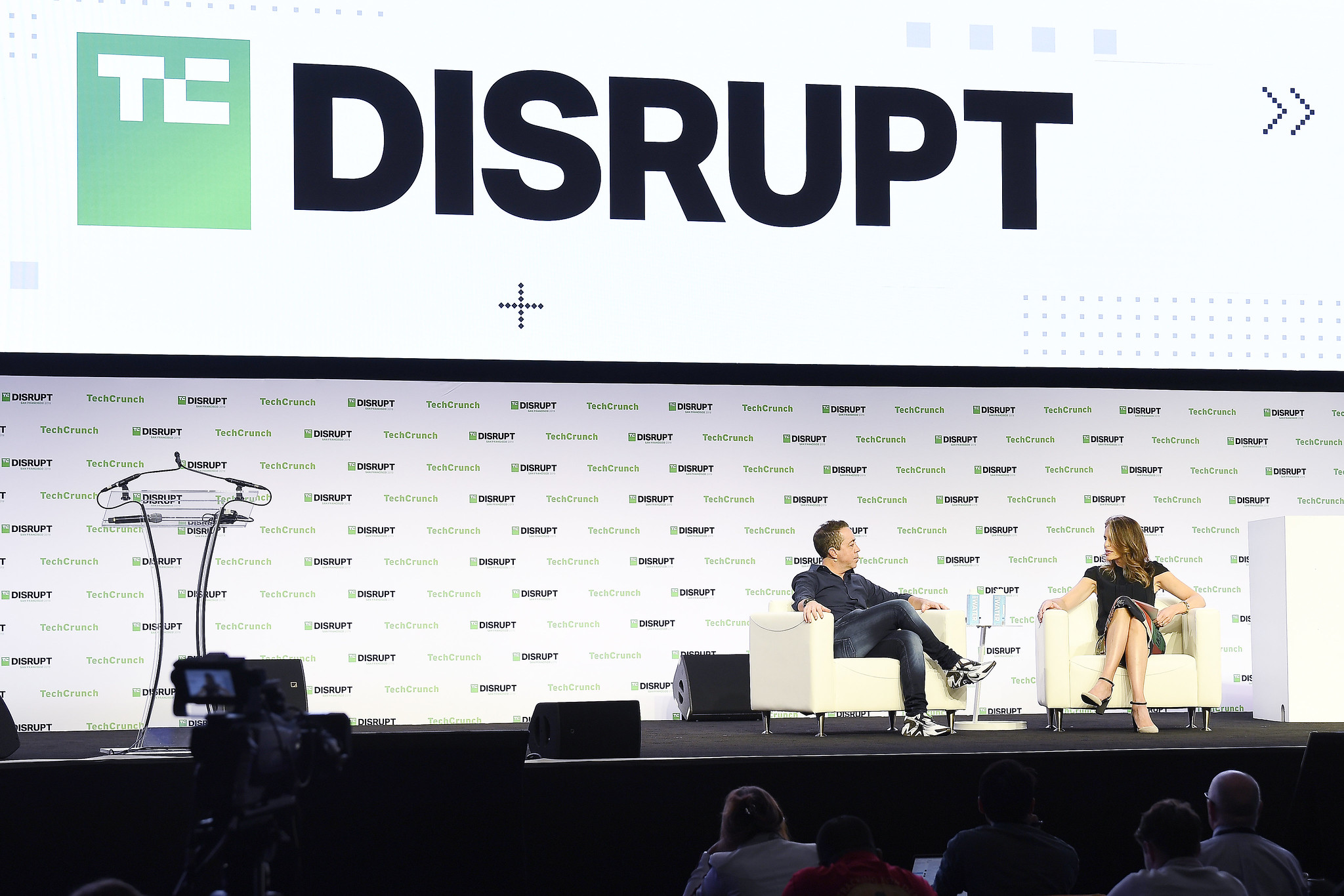
48838201321 4dc8c46891 k

SAN FRANCISCO, CALIFORNIA – OCTOBER 03: (L-R) GV CEO & Managing Partner David Krane speak and TechCrunch Silicon Valley Editor Connie Loizos onstage during TechCrunch Disrupt San Francisco 2019 at Moscone Convention Center on October 03, 2019 in San Francisco, California. (Photo by Steve Jennings/Getty Images for TechCrunch)

TC: When you invested in Uber in 2013, you were investing in a different founder: Travis Kalanick, who was pressured to resign in 2017. It’s a little bit reminiscent of what happened with Adam Neumann of WeWork, who had grown the company over the last nine years and was last week pressured to resign.

Are we in agreement that maybe the investors could have done something sooner? These are two founders whose management styles were very well-known.Why suddenly, was it problematic? And why didn’t someone do something sooner?

DK Well, probably the best advice that I could offer there is it would have been prudent to curb some of Adam’s creativity little bit sooner. . . . But there’s very little similarity between Travis and Adam. Travis is a founder that in his peak at Uber was incredibly enviable, and someone that we chased very aggressively to try and be involved with.

TC: Let’s talk about GV. I think we all want to know more about GV under David Krane. One thing that I noticed is that in the firm’s early days, it would about these discrete pools of capital it was investing. One year, it was ‘We’ve raised $300 million.’ The next it was ‘We’ve been allocated $500 million.’ Is is still the case that you’re getting these yearly allocations? And if so, what are you investing right now?

DK: When we started GV, we had the opportunity to look at several decades of venture capital experience and pick some of the greatest attributes and to do our best to steer away from some things that weren’t optimized. So one of the things that we set up structurally was that yes, we would engage with our single [investor], Alphabet, and figure out what’s a reasonable pool of capital that our team could deploy each year. When we started 10 years ago, we started with literally a $50 million fund. Now 10 years later, we’re investing many hundreds of millions per year.

TC: How much has been allocated [to startups] altogether to this point?

DK: Total? We’re looking after nearly $5 billion.

TC: That’s astonishing. It’s not like Alphabet needs the money, but you did in invest in Uber — good for you. You invested in Nest Labs, which Google bought for $3.2 billion a few years ago. Can you talk about your returns? What percentage of that money has come back to Alphabet?

David Krane GVDSC02847

David Krane, CEO & managing partner of GV, at TechCrunch Disrupt SF 2019 on October 3, 2019

DK: As you know, this is a business often measured in decades. We’re 10 years old this year. And I’ll tell you, kind of directionally, that we’re incredibly happy with the financial performance of the fund. I will say, we’re backed by an investor that has a lot of bravery that puts its shoulder into risk and often tells us, ‘Do  something more complex’ ‘Do something more crazy next time.’ I mean, it wouldn’t be unimaginable that [cofounder] Sergey ]Brin] would walk in and say, ‘Why don’t you do the space elevator next time?’ So sometimes those sorts of businesses may take a lot longer to return. But all in all, we’re incredibly happy with what we’ve returned so far.

TC: When I interviewed your predecessor, Bill Maris, a few years ago, he told me that every decision felt to him and him alone, following what were wide-ranging discussions with the staff whose opinions factored in heavily. But he said, that ultimately, GV is “not like a democracy in any way.”  Are you the ultimate arbiter of what gets funded now at GV?

DK: I would say, technically speaking, we don’t run remarkably differently. That said, our success, and really, the excitement that we bring every day, is really playing a meaningful ‘meta’ team ball. So the experience for the entrepreneur is not so unusual [than] going to any other Sand Hill pitch room, where the entrepreneur would come in and spend an hour or two with us, we would have a dialogue afterwards, we would take some data, we would consult some data, and a discussion with sort of ensue.

Technically, yeah, I can come in and have a little bit of influence on what’s happening. But because we’re scaling what we’re doing,  my objective as often as I can is to green-light as many investments as make sense.

TC: How many investments are you green-lighting here?

DK: I think this year we’ll do 100 deals, in total, in 10 years, we have an active portfolio of more than 300 companies. And I think if memory serves me correctly, we’ve done over 600 deals in 10 years.

TC: How many people are in staff at this point?

DK: Ninety people full time.

TC: It seems like there’s been more focus on elevating women through the ranks.

DK: Absolutely, it’s a big focus for us. We usea page out of the Google playbook that has served the company incredibly well for goal setting and product and engineering called OKRs, for objectives and key results. And we learned that OKRs are actually extensible to diversity and inclusion. So we set some goals a couple of years ago to, most importantly, go out to the market with more focus and do our best to fund a meaningful number of new and underrepresented founders. And I’d say in the last 18 months, we’ve deployed about $200 billion into underrepresented founders.

And conversely, we’ve used that same framework to improve the diversity of our team as well. And I think we’ve made some great progress there.

TC: Is the sort of compensation structure within GV the same as with traditional venture funds with management fees and Kara carry involved? 

DK: We have a single LP, that’s probably one of the most distinctive attributes. But we’re set up mostly like Sand Hill firms, so we have access to all kinds of opportunities to run the business, with carry on our outcomes, [so] all interests are aligned. So it’s a really attractive place to be able to do venture.

TC: When Google formed this unit, 10 years ago, there was also a lot of talk about the data driven nature of investing that you would do. So can you tell me a little bit about the algorithms that you’re relying on and how they help you identify promising companies?

DK: I don’t think it would be Google Ventures without putting some emphasis on the Google part of that name. So using data machine learning has been something that’s very common in our practice for many years. We’ve got a team of something on the order of a dozen [to] focus on technology and how technology can frankly make humans smarter — and we don’t think it’s an either or, we think it’s an and. So we look at technology as an opportunity to analyze deals, discover new opportunities, but really, most importantly, to look at the portfolio at large and ensure that we’ve got the right exposure, we’ve got the right balance, to do our best to capture industry leading returns.

TC: Have you ever gone rogue and defied the data?

DK: We go rogue all the time, Data is there to help us It’s there to make us smarter. But it doesn’t singularly dictate what we do in terms of investment decisions.

TC: What are some of examples of [deals you’ve led that contradicted] the data?

DK: So An example would be a follow-on investment in a company. There may be some some tension between how the data signal will present its view, how other attributes may be more important. And it’s important for us to continue to show support to an entrepreneur, which we try to do as often as we can.
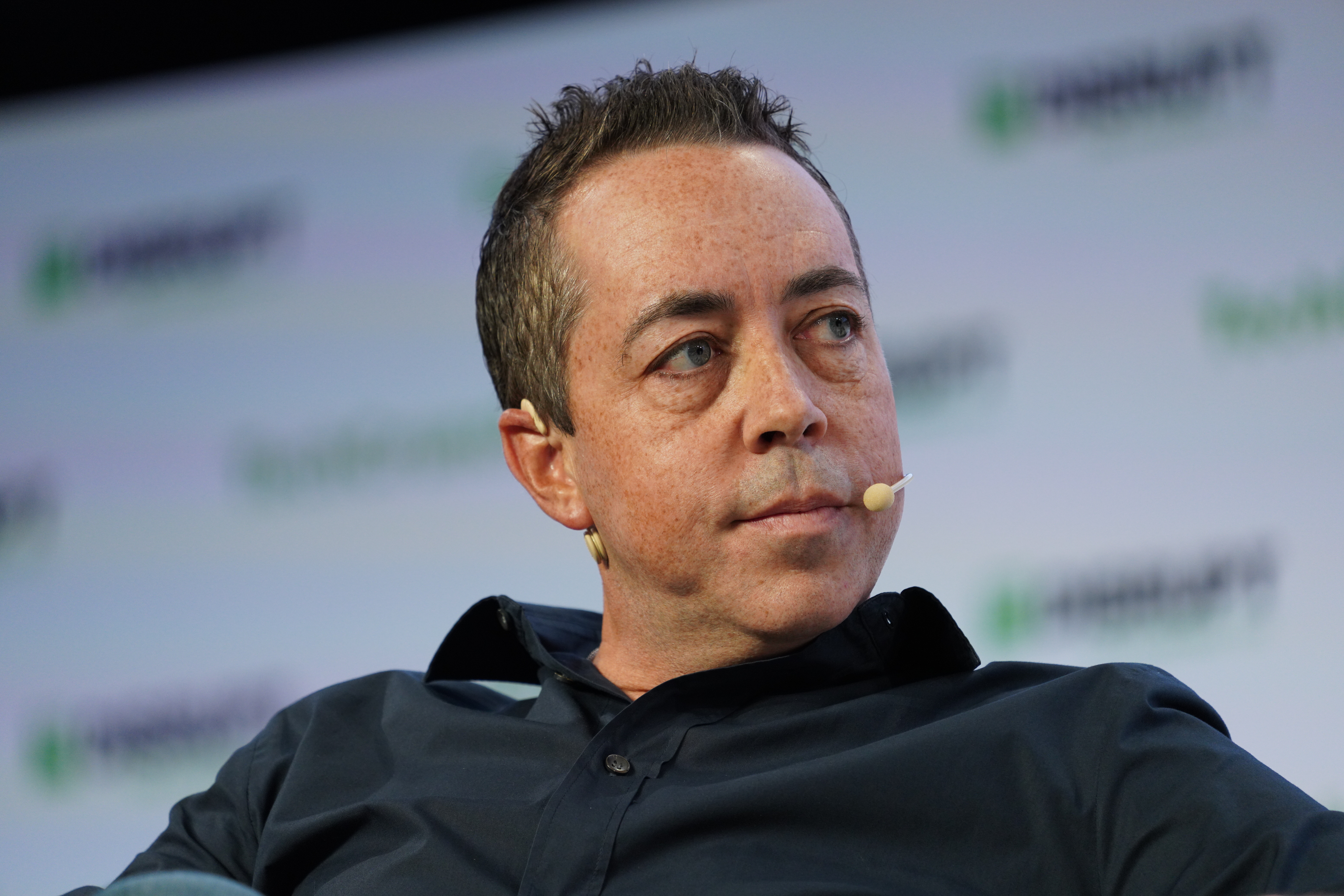
David Krane GVDSC02840

David Krane, CEO & managing partner of GV, at TechCrunch Disrupt SF 2019 on October 3, 2019

TC: You also have a big team here. You also have a team in Europe, but it seems like you’re predominantly still doing venture in the U.S.. Is that accurate?

DK: That’s correct. Yeah, most of our team is situated in a set of offices across the U.S. We’ve got a small team in London, Most of the dollars we invest go into U.S.-based companies and a wide variety of sectors. We do some investing in Europe. We don’t invest in Asia. We don’t invest in Latin America.

TC: Which is so interesting, especially Asia, given there’s so much going on there. In fact, you had told me that you’d invested in a company as a called FreshToHome that’s trying to tackle the fragmented perishable goods market in India.

How much personal investing do you do outside of GV and also, if that company takes off, is there a risk that Larry or Sergey would say, ‘Hey, David, why aren’t we in that deal?’

DK: Well, there’s certainly a chance if that company breaks out and we choose to expand our scope to investing in India that GV could look at it, no question about it. Today, we don’t have plans to invest there. So in markets where GV isn’t investing, we’re happy to support our partners’ personal interests,

I do a little bit of personal investing in categories that honestly have nothing to do with the main line of GV. I invested in a men’s outdoor professional lacrosse League, for example, called PLL, that’s probably not something that GV would do but it’s an area of passion for me; my children play lacrosse.

TC: Why not Asia, though?

DK: I think it’s inevitable that over time as we evolve, will consider taking on a new geography, but focus again, is a feature for our business, too. And I think we have a lot more opportunity to continue to further establish ourselves here.

TC: Shifting gears, let’s talk about bigger-picture stuff. We talked a little bit about Uber. You think Uber is still on sale and an attractive investment; obviously, some people disagree, we’ll see what happens with that company. But more broadly, are companies staying private too long?

DK: No. It’s interesting. There is so much capital in the market right now that there isn’t the burden to put oneself in a position that’s remarkably different from the control, the privacy, that one has is private. So it’s very company specific, your question, but I’d say in general, the market has changed so meaningfully in the last two years that there isn’t that pressure to seek capital in the public markets. You have many, many options to stay private. And for lots of companies, that’s a good thing.

TC: But is it good for Americans? So much wealth has been created before these companies go out, as with Uber, that once they go public, there’s not huge upside [for public market investors]. Taking yourself out of GV, does this [point] resonate at all?

DK: It resonates to some degree. Entrepreneurship is certainly one of the growth factors in this economy. And so we want to see it thrive. We want to see people in the public markets have an opportunity to experience growth and ride the evolution of these companies. But again, I think it’s really a very company specific question.

TC: What about direct listings, which seem to be top of mind, thanks to a confab organized earlier this week by VCs Bill Gurley and Mike Moritz. Since these aren’t fundraising events for companies, it’s hard for me to see these being widely adopted but what do you think?

DK: I think we heard on the stage yesterday from the founder of Slack that direct listings are not quite as clear as some of the benefits have been presented. As you noted, the company doesn’t always get capital. But I think there’s a lot of thinking right now about how to do a direct listing [to] ensure that employees and shareholders on the cap table can get some liquidity, but the company can also seek financing as well.

We were very fortunate to be part of Slack’s direct listing [and] had a great outcome with that. And as an investor, it’s great not to have a lock-up one day one.

TC: But do you think they’ll they’ll pick up momentum or will these be relegated to very special companies?

DK: I think directionally, there’s a huge opportunity to continue to innovate and enhance on on many aspects of how companies [obtain] liquidity. I think they’re promising but we need [more] examples of them. I think it’s a little bit early to tell.

TC: Before you go, there’s a lot of talk about regulating your parent company. Should it be broken up?

DK:  I’ve read the same fear and and focused news articles that you have about this topic. I would say honestly, I’ve been a Google 20 years, It lives inside my veins. I’m very proud of what the company has built. I’m proud to have played a part of that. But I’d say for the last 10 years, having focused on venture capital, I’m really not the most authoritative expert in how Google should think about those sorts of issues. So I’m actually going to take a pass on that one, because we’re focused on something totally different.

TC: Okay. Do you think Facebook should be regulated?

DK: [Laughs.] We can if you like. You know, these are companies that do have a lot of power, they do have a lot of control. But also, the sum of those pieces can be very valuable for consumers and for partners as well. So again, these are these are big, complicated questions. I think these companies will have a lot of questions to answer in the coming months, and we’ll see what happens.


from TechCrunch https://ift.tt/2M8fEHI
via IFTTT

TikTok explains its ban on political advertising

Already under fire for advancing Chinese foreign policy by censoring topics like Hong Kong’s protests and pro-LGBT content, the Beijing-based video app TikTok is now further distancing itself from U.S. social media platforms, like Facebook, Twitter and Instagram, with a ban on political ads on its app.

The company today says it will not allow political ads on TikTok, noting they don’t fit in with the experience the short-form video app aims to offer.

“Any paid ads that come into the community need to fit the standards for our platform, and the nature of paid political ads is not something we believe fits the TikTok platform experience,” says Blake Chandlee, TikTok’s VP of Global Business Solutions, who recently joined the company from Facebook.

“To that end, we will not allow paid ads that promote or oppose a candidate, current leader, political party or group, or issue at the federal, state, or local level – including election-related ads, advocacy ads, or issue ads,” he says.

TikTok further explains that it wants to be known as a place for creative expression, and one that creates a “positive, refreshing environment” that inspires that creativity.

It will further encourage these goals through its products like its fun filters and effects as well as its brand partnerships.

Today, TikTok offers a range of ad opportunities, including in-feed video ads, launch screen ads, and other native ads like its sponsored hashtag challenges. It also more recently launched a beta version of the TikTok Creator Marketplace, which will help to connect brands with TikTok creators for their marketing campaigns.

“Throughout all of this, however, our primary focus is on creating an entertaining, genuine experience for our community,” Chandlee continues. “While we explore ways to provide value to brands, we’re intent on always staying true to why users uniquely love the TikTok platform itself: for the app’s light-hearted and irreverent feeling that makes it such a fun place to spend time,” he says.

Political ads don’t fit with this agenda, the company believes.

But running those sorts of ads also come with significant challenges, as Facebook has found.

It had to create a system to verify the credentials of political advertisers, for example, which requires them to submit identification information like their street address, phone number, business email and website matching the email, tax ID number, or U.S. Federal Election Commmission ID number. It also launched a publicly searchable database of political ads, for transparency’s sake.

As a Chinese-run company, TikTok may not have the resources to run a similar operation. In fact, it seemed to be having trouble cracking down on the hate speech found on its app last year, VICE had reported.

The ban on political ads isn’t really new to TikTok, it’s more of a reiteration of the existing policy — but it’s a statement that TikTok hadn’t made before.


from TechCrunch https://ift.tt/355nOtd
via IFTTT

miércoles, 2 de octubre de 2019

Actor and HitRecord founder Joseph Gordon-Levitt says we should all get off YouTube

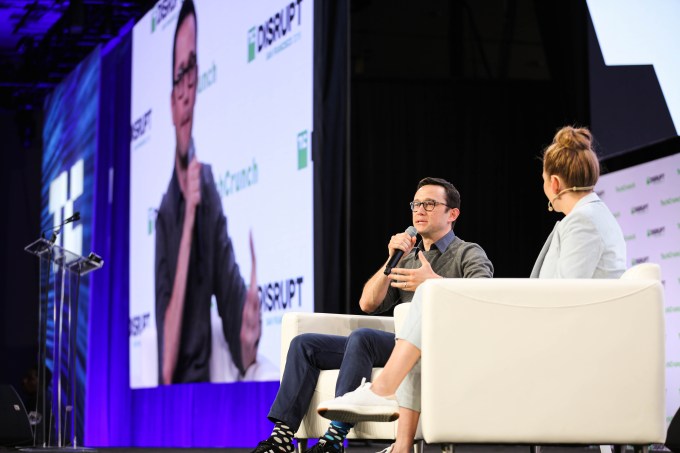
The multi-hyphenate actor-director-entrepreneur, Joseph Gordon-Levitt (best known for roles in “3rd Rock from the Sun,” “Inception,” “Snowden” and, “10 Things I Hate About You,”) came to TechCrunch Disrupt SF 2019 this morning to talk about his startup, the collaborative media platform HitRecord.

Specifically, he addressed how HitRecord differs from other platforms for creators. In doing so, he also called out the YouTube business model as problematic and something we should all get away from. 

The comments around YouTube followed a discussion of some of the criticism HitRecord’s platform has faced — namely, that it doesn’t offer high enough payouts or a way for creatives to make a living.

Since 2010, it has only paid out some $3 million dollars to its creators.

Gordon-Levitt said that HitRecord doesn’t emphasize that you’ll gain entry into the creative industry by using its platform, nor does it market itself as something you can turn into a full-time job, like YouTube often promises.

In fact, he found the YouTube model an issue for the industry and society as a whole.

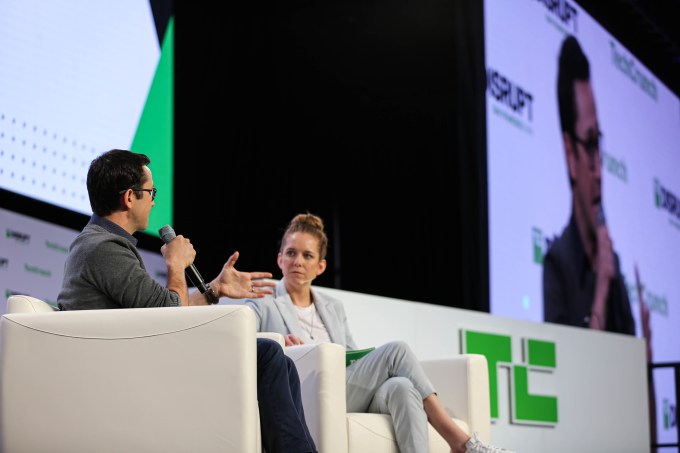
Joseph Gordon-Levitt speaks with Jordan Crook at TechCrunch Disrupt 2019 on October 2, 2019.

Joseph Gordon-Levitt speaks with Jordan Crook at TechCrunch Disrupt 2019 on October 2, 2019.

He said that making art shouldn’t be about the money or external validation — such as likes and subscribers.

“What I have experienced in my life is actually what brings me a lot of joy and happiness about the creative process is not the red carpets. It’s not the box office. It’s not those kinds of external validators. It’s the ‘doing it,’ it’s when I get to actually do the art, and especially do it with other people,” explained Gordon-Levitt.

Of course, he has the comfort of his own Hollywood success to fall back on, when new creators entering the industry don’t.

Asked what he thought of YouTube’s model as well as Instagram’s, Gordon-Levitt had some harsh words.

“Do you think that YouTube and Instagram are a net positive or negative for humans’ creativity?” asked TechCrunch editor Jordan Crook.

He responded quickly that they were a net negative.

Joseph Gordon-Levitt speaks with Jordan Crook at TechCrunch Disrupt 2019 on October 2, 2019.

Joseph Gordon-Levitt speaks with Jordan Crook at TechCrunch Disrupt 2019 on October 2, 2019.

“There’s tons of incredible stuff, beautiful communities form all kinds of creative human expression. It’s not to say that it’s all bad, but I do think that in general the basic business model of: we’re going to offer a quote-unquote ‘free service’ in exchange for the right to conduct mass surveillance, and then apply these incredibly expensive sophisticated machine learning algorithms to this massive data set to optimize for — not the benefit of the users, not what’s going to make the users more creative or more informed or more compassionate or anything — but optimize instead for the agenda of these third-party advertisers; I think that’s a basic business model that we all as the world should get off entirely,” he said. “We shouldn’t be monetizing software, or businesses that way.”

The audience at TechCrunch Disrupt cheered.

As an alternative to these services, Gordon-Levitt promoted the Netflix model as something that works.

There’s a direct billing relationship with the customer, he said, and the data collected is designed to give you more of want you like to watch.

Similarly, HitRecord aims to use data for better purposes.

“I’m all for using data to accomplish a goal that the user has signed up for,” Gordon-Levitt said. “It’s when the user is being subjected to these algorithms not in their interest, but in the interest of some third-party behind the curtain, that’s I think where you get into danger.”


from TechCrunch https://ift.tt/2nWWVqz
via IFTTT

martes, 1 de octubre de 2019

Zuckerberg misunderstands the huge threat of TikTok

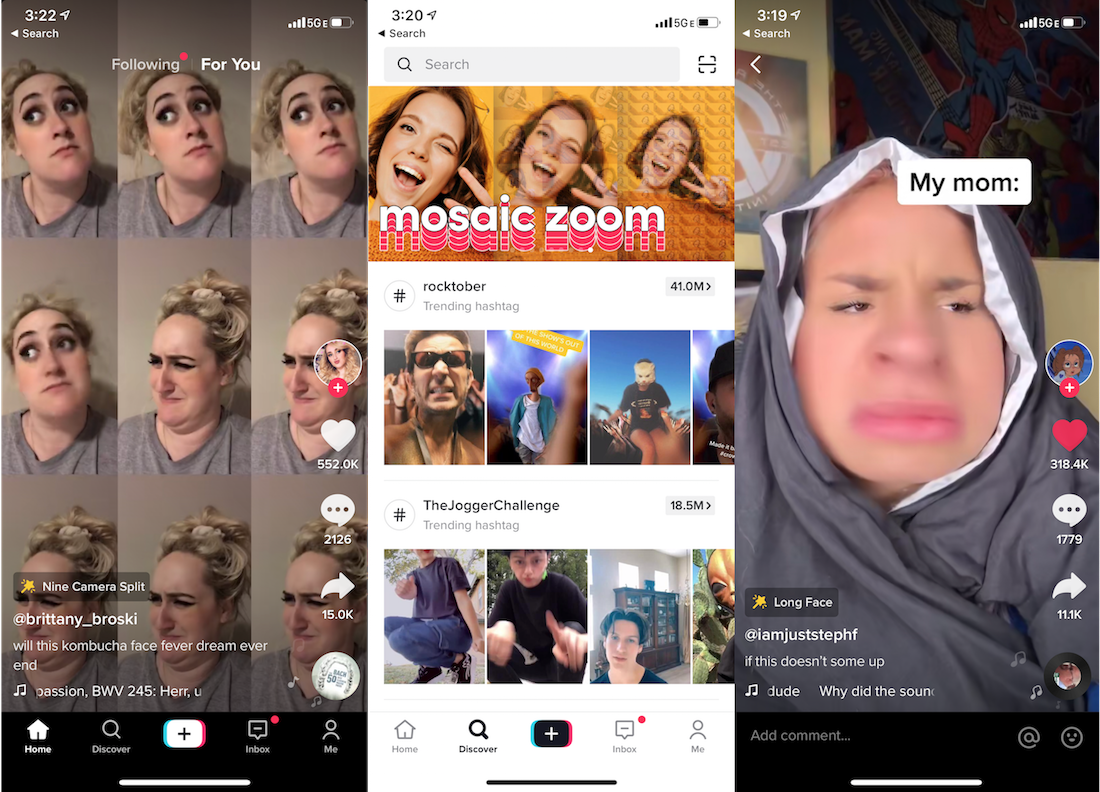
“It’s almost like the Explore Tab that we have on Instagram” said Facebook CEO Mark Zuckerberg in leaked audio of him describing TikTok during an all-hands meeting. But it’s not. TikTok represents a new form of social entertainment that’s vastly different from the lifelogging of Instagram where you can just take a selfie, show something pretty, or pan around what you’re up to. TikToks are premeditated, storyboarded, and vastly different than the haphazard Stories on Insta.

That’s why Zuckerberg’s comments cast a dark shadow over the future of the Facebook family of apps. How can it beat what it doesn’t understand? He certainly can’t ignore it. Facebook’s copycat Lasso has been installed just 425,000 times since it launched in November, while TikTok has 640 million installs in the same period outside of China. Oh, and TikTok has 1.4 billion total installs beyond China to date.

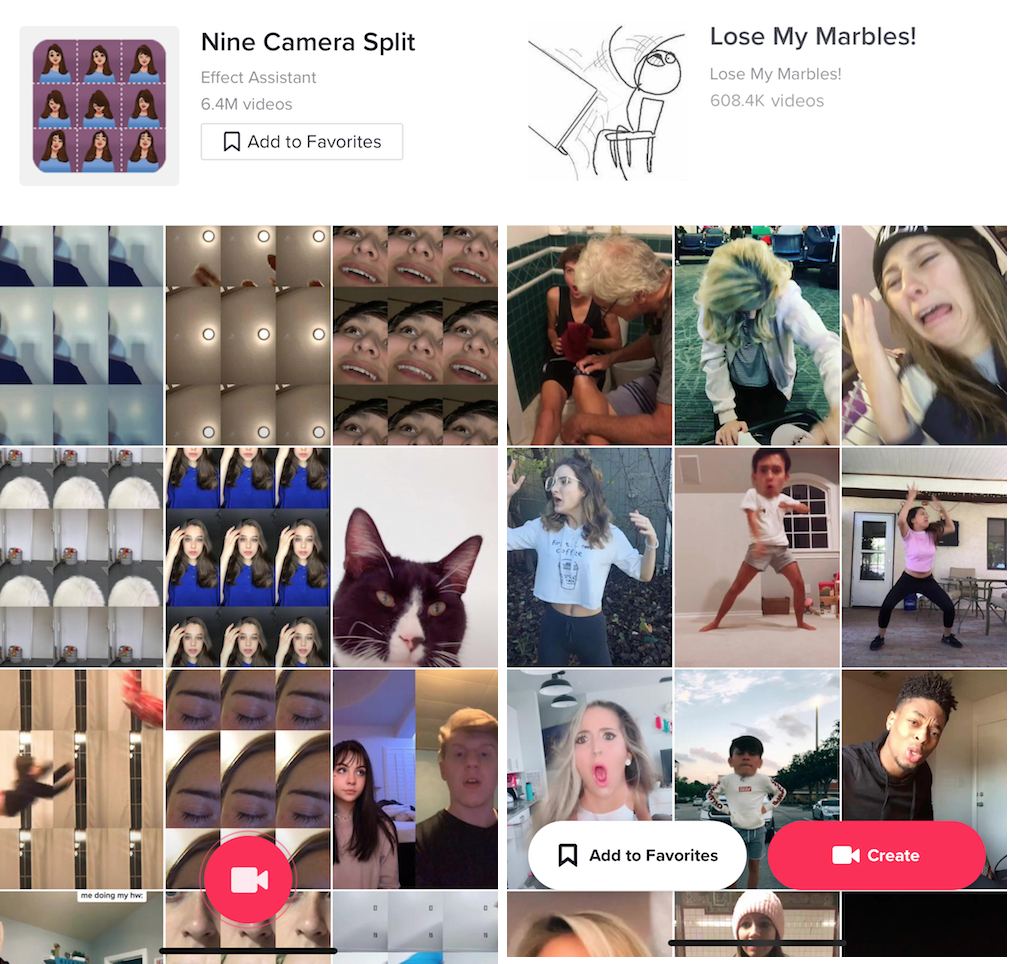
TikTok Screenshots

TikTok

Casey Newton of The Verge today published two hours of audio and transcripts from two internal-only all-hands Q&As held by Zuckerberg at Facebook in July. His comments touch on the company’s plan to fight being broken up by regulators, especially if Elizabeth Warren becomes President. He thinks Facebook would win, but on resorting to suing the government, he says “does that still suck for us? Yeah.” Zuckerberg also describes how Facebook is working to launch a payments product in Mexico and elsewhere by year’s end as Libra deals with regulatory scrutiny.

But beyond his comments on regulation, it’s his pigeonholing of TikTok that’s most alarming. It foreshadows Facebook failing to win one of the core social feeds that its business depends on. Perhaps his perspective on the competitor is evolving, but the leak portrays him as thinking TikTok is just the next Snapchat Stories to destroy.

Zuckeberg’s Thoughts On TikTok

Here’s what Zuckerberg said about TikTok during the internal Q&A sessions, (emphasis mine):

So yeah. I mean, TikTok is doing well. One of the things that’s especially notable about TikTok is, for a while, the internet landscape was kind of a bunch of internet companies that were primarily American companies. And then there was this parallel universe of Chinese companies that pretty much only were offering their services in China. And we had Tencent who was trying to spread some of their services into Southeast Asia. Alibaba has spread a bunch of their payment services to Southeast Asia. Broadly, in terms of global expansion, that had been pretty limited, and TikTok, which is built by this company Beijing ByteDance, is really the first consumer internet product built by one of the Chinese tech giants that is doing quite well around the world. It’s starting to do well in the US, especially with young folks. It’s growing really quickly in India. I think it’s past Instagram now in India in terms of scale. So yeah, it’s a very interesting phenomenon.

And the way that we kind of think about it is: it’s married short-form, immersive video with browse. So it’s almost like the Explore Tab that we have on Instagram, which is today primarily about feed posts and highlighting different feed posts. I kind of think about TikTok as if it were Explore for stories, and that were the whole app. And then you had creators who were specifically working on making that stuff. So we have a number of approaches that we’re going to take towards this, and we have a product called Lasso that’s a standalone app that we’re working on, trying to get product-market fit in countries like Mexico, is I think one of the first initial ones. We’re trying to first see if we can get it to work in countries where TikTok is not already big before we go and compete with TikTok in countries where they are big.

We’re taking a number of approaches with Instagram, including making it so that Explore is more focused on stories, which is increasingly becoming the primary way that people consume content on Instagram, as well as a couple of other things there. But yeah, I think that it’s not only one of the more interesting new phenomena and products that are growing. But in terms of the geopolitical implications of what they’re doing, I think it is quite interesting. I think we have time to learn and understand and get ahead of the trend. It is growing, but they’re spending a huge amount of money promoting it. What we’ve found is that their retention is actually not that strong after they stop advertising. So the space is still fairly nascent, and there’s time for us to kind of figure out what we want to do here. But I think this is a real thing. It’s good.

To Zuckerberg’s credit, he’s not dismissing the threat. He knows TikTok is popular. He knows it’s growing in key international markets Facebook and Instagram depend on to keep user counts rising. And he knows his company needs to respond via its standalone clone Lasso and more.

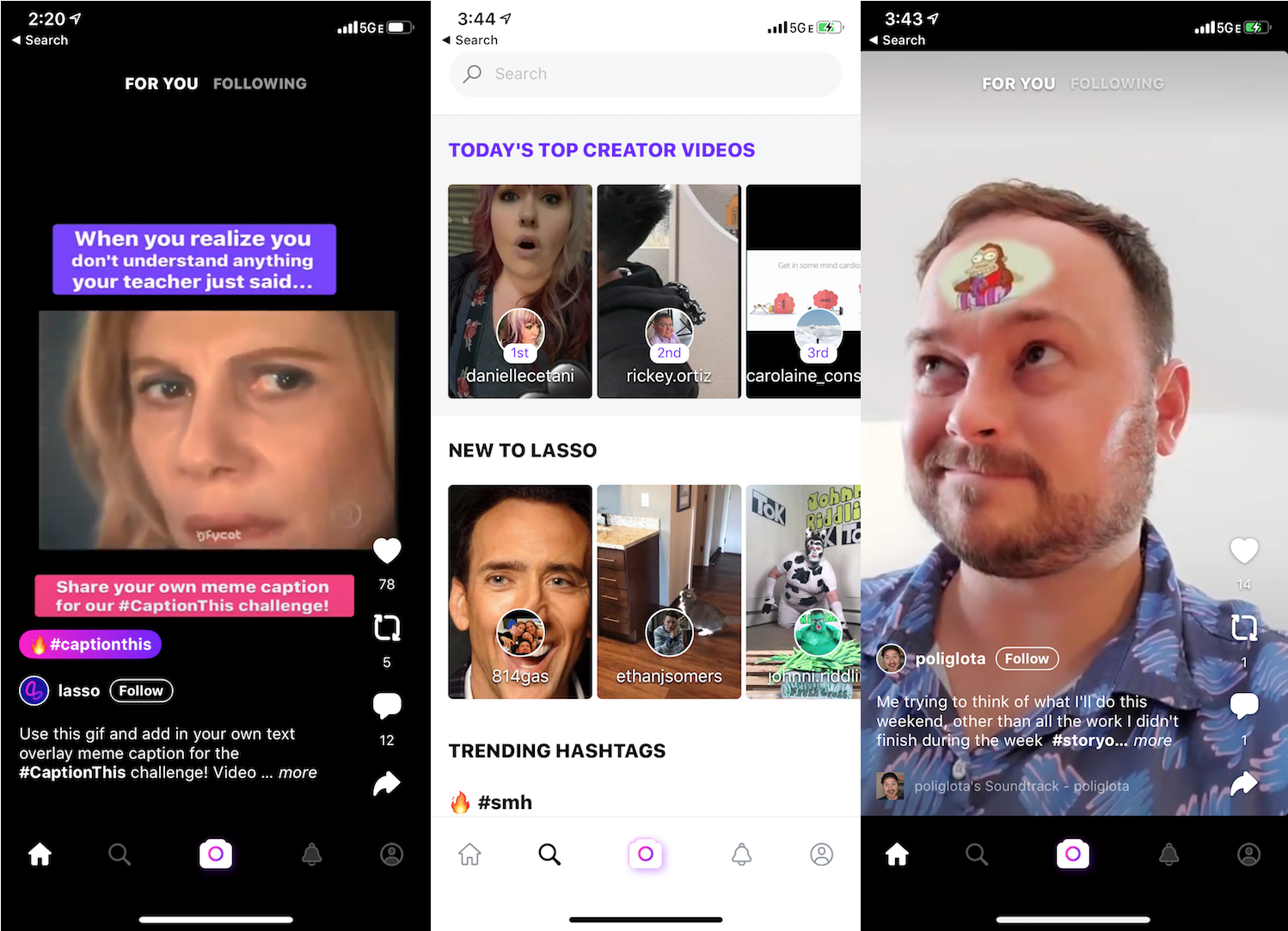
Facebook Lasso Screenshots

Lasso

But while TikToks might look like Stories because they’re vertical videos, and TikTok might algorithmically recommend them to people like Instagram Explore, it’s a whole ‘nother beast of a product and one that may be harder than it seems to copy.

To crystallize why, let’s rewind to Snapchat. With the launch of Stories, it started to blow up with US teens. Facebook’s attempts to clone it in standalone apps like Poke and Slingshot never gained traction. In fact, none of Facebook’s standalone apps have succeeded unless they splintered off an already-popular piece of Facebook like chat and users were forced to download them like Messenger. It wasn’t until Zuckerberg stuck his clone of Stories front-and-center atop Instagram and Facebook that Snapchat’s user count went from growing 18% per quarter to shrinking. There, Facebook used the same strategy laid out in Zuckerberg’s comments — push its good-enough clone in countries where the original isn’t popular yet.

But Facebook was fortunate because Stories really wasn’t that dissimilar to the content users were already sharing on Instagram — tiny biographical snippets of their lives. Snapchat CEO Evan Spiegel had originally invented Stories as a vision of Facebook’s News Feed through the lens of an ephemeral camera. All users had to know was “I take the same videos, but shorter and sillier, posted more often, and then they disappear”. The concept of Instagram and Facebook didn’t have to change. They were still about telling friends what you were up to. Choking off TikTok’s growth will be much more complicated.

Why TikTok Is Tough To Clone

TikTok isn’t about you or what you’re doing. It’s about entertaining your audience. It’s not spontaneous chronicling of your real life. It’s about inventing characters, dressing up as someone else, and acting out jokes. It’s not about privacy and friends, but strutting on the world stage. And it’s not about originality — the heart of Instagram. TikTok is about remixing culture — taking the audio from someone else’s clip and reimagining the gag in a new context by layering it atop a video you record.

TikTok Remixes

That makes TikTok distinct enough that it will be very difficult to shoehorn into Instagram or Facebook, even if they add the remixing functionality. Most videos on those apps aren’t designed to be templates for memes like TikToks are. Insta and Facebook’s social graphs are rooted in friendship and augmented by the beautiful and famous, but don’t encompass the new wave of amateur performers TikTok elevates. And since each post to the app becomes fodder for someone else’s creativity, a competitor starting from scratch doesn’t offer much to remix.

That means a TikTok clone would have to be somewhat buried in Instagram or Facebook, rebuild a new social graph, and retrain users’ understanding of these apps’ purpose…at the risk of distracting from their core use cases. This leaves Facebook hoping to grow its standalone TikTok clone Lasso which TechCrunch scooped a year ago before it launched last November. But as we’ve seen, Facebook struggles growing brand new apps, and that effort is further hindered by its increasingly toxic brand and sheen of uncoolness. Nor does it help that Facebook must divert development resources to comply with all the new privacy and transparency obligations as part of its $5 billion FTC fine and settlement.

The Next Feed

Facebook’s best bet is to assess the future value of the ads it could run on a successful TikTok clone and apply some greater fraction of that grand sum to competing directly. It’s already made some smart additions to Lasso like tutorials for how to remix and the option to add GIFs as sections of your video. But it’s still failing to gain serious traction in the US. While typical TikTok homepage videos have hundreds of thousands of Likes, the top ones I saw in my Lasso feed today received 70 or fewer.

I had Sensor Tower run some analysis comparing TikTok with Lasso since its launch last November, and found that Lasso gets 6 downloads for every 1000 for TikTok in the US. Some more stats:

  • US Total Downloads Since November: Lasso – 250,000 // TikTok – 41.3 million
  • US Downloads Per Day Since November: Lasso – 760 // TikTok – 126,000
  • Average US Google Play Social App Chart Ranking: Lasso – #155 // TikTok – #2

Beyond the US, Lasso has only launched in one other market, Mexico in April, where it’s been faring better but could hardly even be considered a competitor to TikTok. They won’t even coherently fit together on a graph. Facebook needs to lean harder into Lasso:

  • Mexico Total Downloads Since April: Lasso – 175,000 // TikTok – 3.3 million
  • Mexico Downloads Per Day Since November: Lasso – 1,000 // TikTok – 19,000

Facebook Lasso Logo

Zuckerberg may need to find a coherent place for TikTok style features inside Instagram and potentially Facebook. That could be another horizontal row of previews like with Stories and/or a header on the Explore page dedicated to premeditated content. Certainly something more prominent than a single button like IGTV that still no one is asking for. One opportunity to best TikTok would be building a dedicated remix source browser into the Stories camera to help users find content to put their own spin on.

Facebook will also need to buy out top TikTok creators to make videos for it instead, and even quasi-hire some of the most prolific video meme or challenge inventors to give users trends to jump on rather than just one-off clips to watch. Its failure to offer IGTV stars monetization has led many to ignore that platform, and it can’t afford that again.

If Zuckerberg approaches TikTok as merely an algorithmic video recommender like Explore, Facebook will miss out on owning the social entertainment feed. If he doesn’t decisively move to challenge TikTok soon, its catalog of content to remix will grow insurmountable and it will own the whole concept of short form performative video. Snapchat’s insistence on ephemerality makes it incompatible with remixing, and YouTube isn’t nimble enough to reinvent itself.

If no American company can step up, we could see our interest data, faces, and attention forfeited to an app that while delightful to use, heralds Chinese political values at odds with our own.


from TechCrunch https://ift.tt/2nqeOxP
via IFTTT