martes, 19 de noviembre de 2019

Sundance Institute’s Co//ab offers online education and feedback for filmmakers

The Sundance Institute is looking to reach a broader community of up-and-coming filmmakers with a new website called Co//ab.

The institute’s chief product officer Tara Hein-Phillips told me that a small pilot version of the site first launched early in 2018, before beginning a “proper beta” in November of that year. And it spent a full year in beta testing — growing to 20,000 members — before Sundance took the label off earlier this month.

Hein-Phillips described Co//ab as an extension of the institute’s existing artist’s programs — leveraging the internet so that the programs can “have more impact.” There are plenty of other filmmaking tutorials out there (I’m both tickled and tempted by the existence of this David Lynch MasterClass), but she said they tend to be “inspirational,” whereas Co//ab is designed to be “more practical, more hands-on.”

“We really wanted the sweet spot to focus around works in progress — to give artists a completely safe and trusted space with other artists to take that work to the next level,” she said. “That’s its whole purpose in the world.”

So Co//ab offers a general library of instructional videos, but also more in-depth courses and master classes. There’s also an opportunity to participate in monthly challenges (the current one involves rewriting an unsatisfying final scene) and to share scripts and films for feedback from other members of the Sundance community.

Asked about whether that feedback ever gets too harsh, Hein-Phillips noted that there’s a very “hands-on” community manager.

“We really do work to cultivate the spirit of generosity,” she added. “In part, it’s a little bit in reaction too what we’ve seen in online community today. We’re really trying to allow artists to redefine what online community is … We’re seeing that really happen. We get so little negative feedback toward other people.”

Access to the video library is free, with pricing starting at $10 per month for a membership that includes members-only webinars and feedback on your work. There’s an additional fee for the individual classes — but Hein-Phillips noted that Co//ab will be offering need-based scholarships to 20% of all participants.

“We’re clearly a not-for-profit,” she said. “Our goal is not to make money with this. We’d like it to be self-sustaining, and if it did happen to make money, that would filter back to our artist’s programs.”


from TechCrunch https://ift.tt/2QFAvWV
via IFTTT

viernes, 15 de noviembre de 2019

TikTok tests social commerce

TikTok is beginning to dabble in social commerce. The short-form video app said it has started to allow some users to put links to e-commerce sites, or any other destination, as well as introduced the ability to have creators quickly send their viewers to shopping websites.

The company said the roll-out of these two features are part of its usual “experimentation” to improve app experience for users. Though, this particular experimentation could significantly change how lucrative influencers find TikTok.

A spokesperson of ByteDance, one of the world’s most valuable startups that also owns TikTok, said, “We’re always experimenting with new ways to improve the app experience for our users. Ultimately, we’re focused on ways to inspire creativity, bring joy, and add value for our community.”

These features were first spotted and shared by Fabian Bern, founder of influencer startup Uplab. In a video he tweeted on Thursday, Bern showed how it was possible for the first time for creators to give their viewers the ability to visit a third-party website.

In the video, we also see TikTok is allowing users to put a URL in their profile bio. Instagram has long allowed this functionality, which a large number of accounts use for a variety of reasons. While influencers usually direct their fans to merchandise stores, some news publishers use it to drive people to news articles. The current set of restrictions on Instagram, however, leave a lot to be desired.

If TikTok, which has amassed over a billion users, retains these features it could disrupt what many industry figures call “social commerce.” Social media companies and messaging apps in recent years have lured customers through their core services and introduced shopping features.

In many markets such as China, Southeast Asia and India, which happens to be one of TikTok’s biggest markets, social commerce is increasingly becoming popular and beginning to pose a challenge to “traditional” e-commerce players such as Amazon.

And major giants are beginning to see an opportunity in this space. Facebook, which offers a marketplace, this year backed Meesho, an Indian social commerce startup.

Meesho connects buyers and sellers on WhatsApp and other social media platforms, enables them to showcase and sell their goods, and works with a range of logistics companies to service their orders.

“This is big!” said Nameet Potnis, head of business growth and marketing for the India unit of Naspers’ global payments firm PayU, of TikTok’s new features.

“Excited to see how this is going to reshape commerce in tier 2/3 India where TikTok rules over Instagram. As Indians get comfortable with buying and paying online, local influencers will change the game.”

TikTok’s experimentation comes at a time when rival Instagram is beginning to expand a test in which it hides “likes” from public view. The move has caused concerns for influencers, who count on likes to inform advertisers of their reach.

TikTok, which has amassed over 180 million users in India and thousands of influencers in the country, last month expanded to education category in India.


from TechCrunch https://ift.tt/33PBQhl
via IFTTT

miércoles, 13 de noviembre de 2019

John Carmack steps down at Oculus to pursue AI passion project ‘before I get too old’

Legendary coder John Carmack is leaving Facebook’s Oculus after 6 years to focus on a personal project — no less than the creation of Artificial General Intelligence, or “Strong AI.” He’ll remain attached to the company in a “Consulting CTO” position, but will be spending all his time working on, perhaps, the AI that finally surpasses and destroys humanity.

AGI or strong AI is the concept of an AI that learns much the way humans do, and as such is not as limited as the extremely narrow machine learning algorithms we refer to as AI today. AGI is the science fiction version of AI — HAL 9000, Replicants, and of course the Terminator. There are some good ones out there, too — Data and R2D2, for instance.

So far AGI has yet to be even defined in any serious way, let alone approached by researchers. It’s an open question whether such a thing is even possible, and if it is, whether we can accomplish it — and if we can, whether we should.

Carmack announced the move on Facebook, where he explained that the uncertainty about such a fascinating and exciting topic is exactly what attracted him to it.

When I think back over everything I have done across games, aerospace, and VR, I have always felt that I had at least a vague “line of sight” to the solutions, even if they were unconventional or unproven. I have sometimes wondered how I would fare with a problem where the solution really isn’t in sight. I decided that I should give it a try before I get too old.

His plan is to pursue it from home, “Victorian Gentleman Scientist” style, and make his kid help. It’s a bit like someone retiring early to dedicate their life full-time to the perpetual motion machine they’ve almost got working… except Carmack may actually have a chance to create something remarkable.

His is the rare combination of a technical mind combined with vision and creativity, leading him to skim the bleeding edge of technology and sometimes give it a serious push in some direction or another.

Unlike his work at Oculus, however, we won’t be able to buy the result of his expert touch, so we’ll just have to wait for whatever comes out of it, if anything. I wish him good luck — but I also wish he’d be careful.


from TechCrunch https://ift.tt/33LUS8q
via IFTTT

martes, 12 de noviembre de 2019

Introducing the TC Top Picks for Disrupt Berlin 2019

Can we get a fanfare of trumpets, please? The time has come to introduce you to our TC Top Picks for Disrupt Berlin 2019. The ingenuity and creativity reflected in the international startup community can’t be overstated, and narrowing the field from the hundreds of applications we received was no easy task.

The program showcases outstanding early-stage startups across these categories: AI/Machine Learning, Biotech/Healthtech, Blockchain, Fintech, Mobility, Privacy/Security, Retail/E-commerce, Robotics/IoT/Hardware, CRM/Enterprise and Education.

Challenging as it was, TechCrunch editors had a (wicked fun) job to do — select up to five early-stage startups they felt represent the best of their specific tech category. This remarkable cadre of early-stage startups knocked our proverbial socks off. Cold toes notwithstanding, we think you’ll be equally impressed.

Founders who earn the TC Top Picks designation receive a free Startup Alley Exhibitor Package, one full day of exhibiting, three free Founder passes, intense investor and media interest and VIP treatment — including an interview on the Showcase Stage with a TechCrunch editor. And we promote that video across our social media platforms.

Alright, it’s time for the big reveal. Congratulations to the TC Top Picks for Disrupt Berlin 2019!

Artificial Intelligence + Machine Learning

  • Apostera: An automotive company offering a set of innovative products world-wide.
  • CYANITE: Music analysis tool — the interface between the music industry, data science and software engineering.
  • Prodsight: Helps companies make data-driven product development decisions.
  • Stormly: An AI-powered platform that works as a data consultant.
  • Timekettle Technologies: Committed to building a global brand of AI translator so immersive that it disappears into the experience.

Biotech + Healthtech

  • Glazomer: An affordable Hi-End Eye Tracking system for professional academic and clinical research.
  • Healthy Quit: Digital health company and a pharmacy that provides vaping and smoking cessation by utilizing an artificial intelligent treatment algorithm and medications to help patients quit.
  • mettleAI: Leveraging ML/AI to predict substance abuse relapse before it happens.
  • Thryve: We power the individualization of health care by providing the API needed by health services to access health data from more than 100 wearables.
  • Volta Medical: Aims at developing a wide range of intelligent software solutions designed to guide cardiologists during interventional procedures.

Blockchain

  • Acatena AG: IoT & Blockchain platform to reinvent premium product authenticity.
  • Anytype: An operating system for the new internet.
  • etoshi: The all-in-one crypto platform: trading, wallets and taxes under one roof!
  • SIMBA Chain: A cloud-based, smart-contract-as-a-service (SCaaS) platform, enabling users across a variety of skill sets to implement dapps (decentralized applications).

CRM + Enterprise

  • Cumul.io: A cloud analytics platform for business experts & SaaS companies to integrate intuitive yet powerful data visualization into their daily lives.
  • cux.io: Your one-stop shop for understanding your users’ experiences online.
  • Radicalbit: Event stream processing self-service platform. One platform for data engineering, data ops & MLOps on top of Kafka.
  • Stack: Internet launchpad, increasing the efficiency of working with the web for the average internet users by allowing simultaneous use of multiple web-apps within a neatly organized working environment.
  • Usercentrics: A CMP that helps enterprise customers obtain, manage and document the user consent, with all different aspects of consent storage, consent API’s, consent in ad tech.

Fintech

  • ChromaWay: Blockchain “2.0” platform that enables smart contracts and digital assets for financial applications and non-financial applications.
  • CurioInvest: A technology platform that lets anyone invest directly in rare alternative assets.
  • Raison: A platform for operations with investments and personal finance.
  • TXC Markets: Peer to peer fintech trading technologies and marketplaces for illiquid and alternative assets.

Mobility + Transportation

  • DUCKT: The world’s first universal electrical scooter charging station. Better operations, better experience for people & the city.
  • MachineMax: Used to track utilisation, idling, fuel and geolocation for any machine.
  • Pixmoving: Provides universal autonomous driving chassis.
  • Qibus: Making autonomous mobility a reality.
  • TRAXIT: Tracking multi service company changing the way we track our belongings, starting from Aviation vertical.

Privacy + Security

  • Nect: Delivers the self-service future of identity verification as a service — easy to use and with military-grade security.
  • o.vision: Develops facial identification solutions for integration within smart office frameworks and commercial bank security systems.
  • Sypher Solutions: Software platform that simplifies analysis and helps prevent mistakes when documenting and maintaining GDPR compliance.
  • Wire: The most secure collaboration platform, transforming the way business’ communicate in the same way and speed that our founders disrupted telephony with Skype.

Retail + E-commerce

  • combyne: A social tool for combining clothing. Our vision is to digitize the usage of fashion.
  • Fashwire: A global data-driven marketplace with 200+ fashion designers from 25+ countries.
  • Squareshot: We help consumer, fashion and dnvb brands streamline content production and create beautiful product shots to maximize their online sales.

Robotics + Hardware + IoT

  • Aether Biomedical: A rehabilitation robotics startup focused on building bionic limbs for upper limb amputees.
  • Domotron: The most advanced smart home that adapts to your lifestyle. To make your life easier.
  • Infocode: Smart building solution company that provides smart waste bin for office and public spaces.
  • RoboChef: World’s first fully automated robotic kitchen cooking 500+ recipes with ZERO manual effort powered by IoT, Robotics & AI.

Disrupt Berlin 2019 takes place on 11-12 December. Buy your pass today and be sure to swing by Startup Alley to meet and greet the TC Top Picks. One more thing. It’s not too late to buy a Startup Alley Exhibitor Package and strut your stuff alongside hundreds of companies and sponsors. All exhibiting startups have a shot at winning the Wild Card to compete for $50,000 in our famous pitch competition, Startup Battlefield. What have you got to lose? Nuthin!


from TechCrunch https://ift.tt/2q3zw7R
via IFTTT

lunes, 11 de noviembre de 2019

Smartphone maker Realme is taking India and other emerging markets by storm

As Xiaomi widens its smartphone lead over Samsung in India, a new competitor is increasingly posing a challenge.

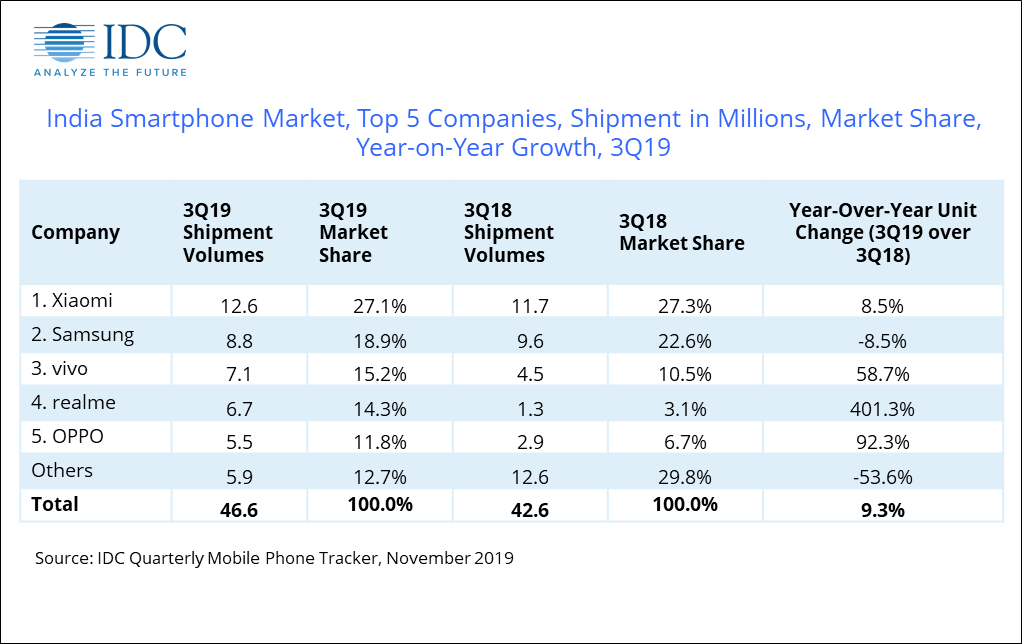
Realme, a one-and-half-year-old smartphone vendor that spun out of Oppo, commanded 14.3% of the world’s second largest smartphone market in the quarter that ended in September, research firm IDC said on Monday.

While Xiaomi, with 27.1% of the local smartphone market share, still dominates the market, the volume of handsets that Realme has shipped in India rose at a staggering 401.3% since the same period last year, according to IDC.

Market share of smartphone vendors in India

What’s fascinating about Realme’s expansion in India is just how closely it is replicating Xiaomi’s playbook in the country. Like Xiaomi, Realme for a year sold phones only through an online channel to cut overhead costs. Last quarter, the company began selling phones in India through offline stores, which still account for more than two-thirds of all smartphone sales.

In terms of online-only shipment, the company’s market share has ballooned to 26.5% in Q3 2019 from 16.5% in Q2 this year, the research firm said.

Realme has launched more than a dozen aggressively priced smartphone models so far, all priced between $80 to $240 — the sweet spot in the local market. In fact, IDC says Realme’s C2, 3i and 3 models — priced between $80 and $110 — were the top-selling phones for the company in Q3 this year.

Like Xiaomi’s handsets, Realme smartphones pack above the punch — sporting some of the highest-end hardware modules for their price range. The $80 Realme C2 features a six-inch HD+ display, 3+2 rear megapixel cameras, 4,000 mAh battery, 2GB of RAM and 16GB of expandable storage — and it supports 4G networks and has a facial unlock feature.

Other markets

Realme today operates in 18 countries, including its home market China, Indonesia, Malaysia, Pakistan, Vietnam and Egypt. In May this year, the company entered the European region.

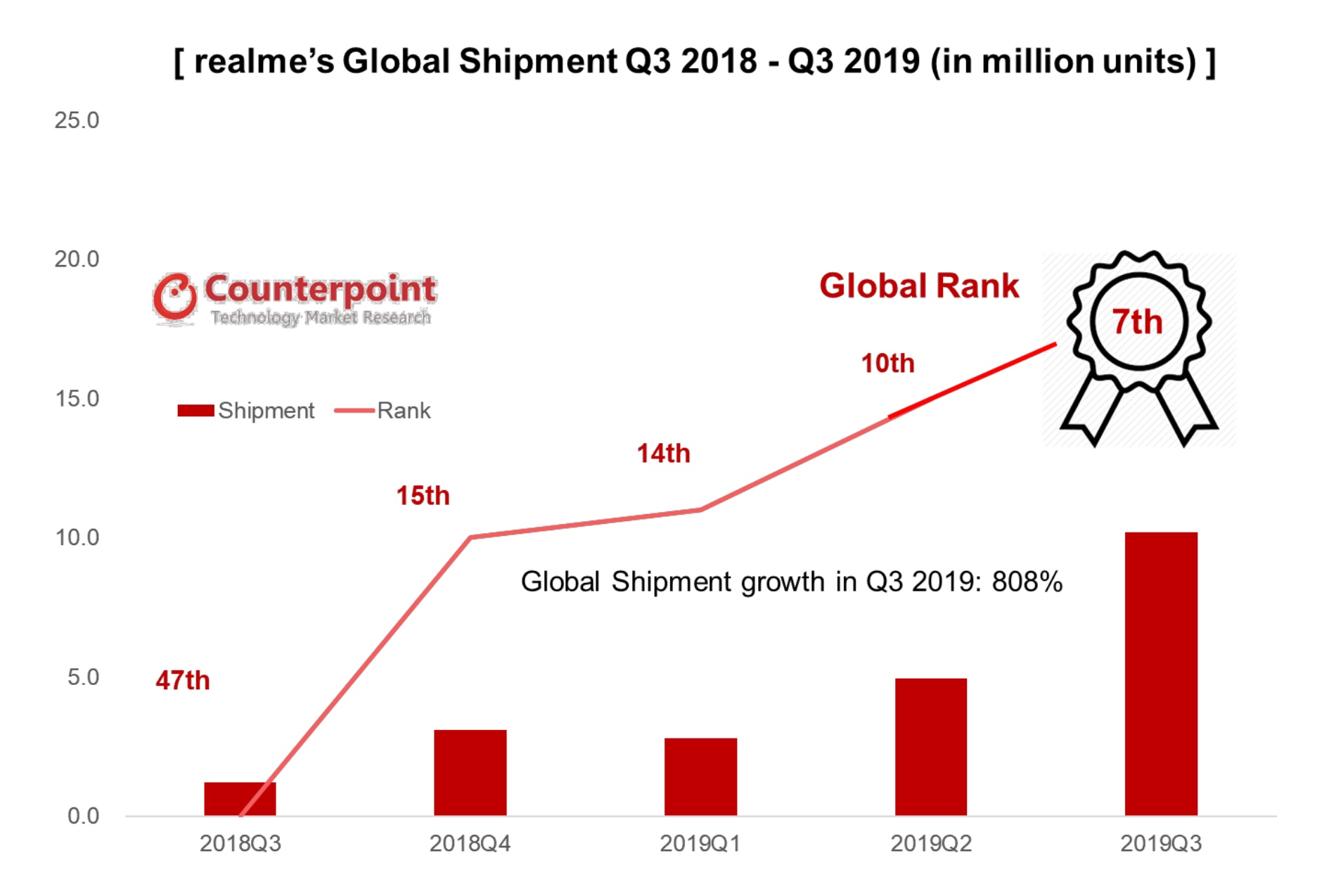
In a report Counterpoint shared with its clients recently, the research firm said that based on the number of smartphones that Realme has shipped, the company’s rank went from 47th in Q3 2018 to 7th as of September this year. By shipping more than 10 million smartphones, the Chinese firm’s shipment grew by a whopping 808% during this period, the research firm said.

India and Indonesia accounted for more than 80% of smartphones that Realme has shipped to date, according to Counterpoint.

“We expect realme to become a serious contender in the market next year as growth will continue in emerging markets and online channels. The value for money proposition is also powerful in times of stagnant economic growth globally,” Counterpoint analysts wrote.

The aggressive growth of Realme hasn’t gone unnoticed with Xiaomi. The two companies have already exchanged testy words with one another and made allegations.

And you thought smartphone wars were over.


from TechCrunch https://ift.tt/2XbYWwk
via IFTTT

viernes, 8 de noviembre de 2019

Prices increase tonight: Buy Disrupt Berlin 2019 early bird passes now

We get it. You’re deep in the weeds starting your startup, building your business, expanding your empire. Startuppers are frequently overworked, prone to procrastination and last-minute decision making.

We’re here to tell you today’s the last day you can score early bird savings to Disrupt Berlin 2019. The early bird deadline ends tonight at 11:59 p.m. (CEST). Don’t pay more than necessary. Beat the deadline, and buy your early bird pass to Disrupt Berlin right now.

As usual, we have a great lineup of speakers, and you’ll learn from the best at Disrupt. Here are just a few examples of what’s on tap. For more detail, go study the Disrupt Berlin 2019 agenda.

Growing from a humble garage project into a global competitor may be possible, but easy? Not so much. Learn the fine art of scaling your startup from a panel of experts who’ve been to the mountaintop. You’ll hear from Holger Seim, founder and CEO of Blinkist, Karoli Hindriks, founder and CEO of Jobbatical and Sophie Alcorn, founding partner of Alcorn Immigration Law.

Brexit — the mere word strikes uncertainty in the hearts of U.K. and European startups. Talk about jangled nerves. We’ll hear three experts discuss decision making in the face of Brexit’s chaotic landscape. Investor Bindi Karia, founder Glenn Shoosmith and VC Volker Hirsch offer their unique perspectives on how to make the right decisions in the face of these obstacles.

If you’re into rapidly changing landscapes, don’t miss eToro’s Yoni Assia and Charlie Delingpole of ComplyAdvantage as they talk fintech. You’ll hear lessons they learned along the way and how today’s startups can change the future of finance.

Hiroki Takeuchi, GoCardless co-founder, CEO and fintech expert, has led the eight-year-old company to the point where it has a shot at becoming a global leader in direct debit payments. He’ll join us to talk about resilience and why he sees a big opportunity for B2B use cases.

There’s so much more to take in at Disrupt Berlin. What happens when you mix creativity and raw talent and then subject it to intense pressure? Head on over to the Extra Crunch Stage to watch the Hackathon finalists pitch products they designed, coded and created in 24 hours. Who will win the individual sponsored challenges and who will win $5,000 from TechCrunch editors for best overall hack?

Disrupt Berlin 2019 takes place on 11-12 December, and you have just a few hours left to take advantage of early bird pricing. Buy your early bird pass before 11:59 p.m. (CEST) tonight and save up to €500.

Is your company interested in sponsoring or exhibiting at Disrupt Berlin 2019? Contact our sponsorship sales team by filling out this form.


from TechCrunch https://ift.tt/2WUeuEJ
via IFTTT

miércoles, 6 de noviembre de 2019

Tinder’s interactive video series ‘Swipe Night’ is going international next year

Tinder’s big experiment with interactive content — the recently launched in-app series called Swipe Night — was a success. According to Tinder parent company Match during its Q3 earnings this week, “millions” of Tinder users tuned into to watch the show’s episodes during its run in October, and this drove double-digit increases in both matches and messages. As a result, Match confirmed its plans to launch Tinder’s new show outside the U.S. in early 2020. 

Swipe Night’s launch was something of a departure for the dating app, whose primary focus has been on connecting users for dating and other more casual affairs.

The new series presented users with something else to do in the Tinder app beyond just swiping on potential matches. Instead, you swiped on a story.

Presented in a “choose-your-own-adventure” style format that’s been popularized by Netflix, YouTube, and others, Swipe Night asked users to make decisions to advance a narrative that followed a group of friends in an “apocalyptic adventure.”

Swipe Night ChoiceThe moral and practical choices you made during Swipe Night would then be shown on your profile as a conversation starter, or as just another signal as to whether or not a match was right for you. After all, they say that the best relationships come from those who share common values, not necessarily common interests. And Swipe Night helped to uncover aspects to someone’s personality that a profile would not — like whether you’d cover for a friend who cheated, or tell your other friend who was the one being cheated on?

The 5-minute long episodes ran every Sunday night in October from 6 PM to midnight.

Though early reports on Tinder’s plans had somewhat dramatically described Swipe Night as Tinder’s launch into streaming video, it’s more accurate to call Swipe Night an engagement booster for an app that many people often find themselves needing a break from. Specifically, it could help Tinder to address issues around declines in open rates or sessions per user — metrics that often hide behind what otherwise looks like steady growth. (Tinder, for example, added another 437,000 subscribers in the quarter, leading to 5.7 million average subscribers in Q3).

Ahead of earnings, there were already signs that Swipe Night was succeeding in its efforts to boost engagement.

Tinder said in late October that matches on its app jumped 26% compared to a typical Sunday night, and messages increased 12%.

On Tinder’s earnings call with investors, Match presented some updated metrics. The company said Swipe Night led to a 20% to 25% increase in “likes” and a 30% increase in matches. And the elevated conversation levels that resulted from user participation continued for days after each episode aired. Also importantly, the series helped boost female engagement in the app.

“This really extended our appeal and resonated with Gen Z users,” said Match CEO Mandy Ginsberg. “This effort demonstrates the kind of creativity and team we have a tender and the kind of that we’re willing to make.”

Swipe Night

The company says it will make Season 1 of Swipe Night (a hint there’s more to come) available soon as an on-demand experience, and will roll out the product to international markets early next year.

Swipe Night isn’t the only video product Match Group has in the works. In other Match-owned dating apps, Plenty of Fish and Twoo, the company is starting to test live streaming broadcasts. But these are created by the app’s users, not as a polished, professional product from the company itself.

Match had reported better-than-expected earnings for the third quarter, with earnings of 51 cents per share — above analysts’ expectations for earnings of 42 cents per share. Match’s revenue was $541 million, in line with Wall St.’s expectations.

But its fourth-quarter guidance came in lower than expectations ($545M-$555M, below the projected $559.3M), sending the stock dropping. Match said it would have to take on about $10 million in expenses related to it being spun out from parent company IAC.


from TechCrunch https://ift.tt/32sjX73
via IFTTT