jueves, 23 de enero de 2020

It’s time for tech startups to get political

Between 2005 and 2018, the five biggest U.S. tech firms collectively spent more than half a billion dollars lobbying federal policymakers. But they shelled out even more in 2019: Facebook boosted its lobbying budget by 25%, while Amazon hiked its political outlay by 16%. Together, America’s biggest tech firms spent almost $64 million in a bid to shape federal policies.

Clearly, America’s tech giants feel they’re getting value for their money. But as CEO of Boundless, a 40-employee startup that doesn’t have millions of dollars to invest in political lobbying, I’m proposing another way. One of the things we care most about at Boundless is immigration. And while we’ve yet to convince Donald Trump and Stephen Miller that immigrants are a big part of what makes America great — hey, we’re working on it! — we’ve found that when you have a clear message and a clear mission, even a startup can make a big difference.

So how can scrappy tech companies make a splash in the current political climate? Here are some guiding principles we’ve learned.

1) Speak out

You can’t make a difference if you don’t make some noise. A case in point: Boundless is spearheading the business community’s pushback against the U.S. Department of Homeland Security’s “public charge rule.” This sweeping immigration reform would preclude millions of people from obtaining U.S. visas and green cards — and therefore make it much harder for American businesses to hire global talent — based on a set of new, insurmountable standards. We’re doing that not by cutting checks to K Street but by using our own expertise, creativity and people skills — the very things that helped make our company a success in the first place.

By leveraging our unique strengths — including our own proprietary data — we’ve been able to put together a smart, business-focused amicus brief urging courts to strike down the public charge rule. And because we combine immigration-specific expertise with a real understanding of the issues that matter most to tech companies, we’ve been able to convince more than 100 other firms  — such as Microsoft, Twitter, Warby Parker, Levi Strauss & Co. and Remitly — to cosign our amicus brief. Will that be enough to persuade the courts and steer federal policy in immigrants’ favor? The jury’s still out. But whatever happens, we take satisfaction in knowing that we’re doing everything we can on behalf of the entire immigrant community, not just our customers, in defense of a cause we’re passionate about.

2) Take a stand

Taking a stand is risky, but staying silent is a gamble, too: Consumers are increasingly socially conscious, and almost nine out of 10 said in one survey that they prefer to buy from brands that take active steps to support the causes they care about. It depends a bit on the issue, though. One survey found that trash-talking the president will win you brownie points from millennials but cost you support among Baby Boomers, for instance.

So pick your battles — but remember that media-savvy consumers can smell a phony a mile off. It’s important to choose causes you truly stand behind and then put your money where your mouth is. At Boundless, we do that by hiring a diverse workforce — not just immigrants, but also women (we’re over 60%), people of color (35%) and LGBTQ+ (15%) — and putting time and energy into helping them succeed. Figure out what authenticity looks like for your company, and make sure you’re living your values as well as just talking about them.

3) Band together

Tech giants might have a bigger megaphone, but there are a lot of startups in our country, and quantity has a quality all its own. In fact, the Small Business Administration reported in 2018 that there are 30.2 million small businesses in the United States, 414,000 of which are classified as “startups.” So instead of trying to shout louder, try forging connections with other smart, up-and-coming companies with unique voices and perspectives of their own.

At Boundless, we routinely reach out to the other startups that have received backing from our own investor groups — national networks such as Foundry Group, Trilogy Equity Partners, Pioneer Square Labs, Two Sigma Ventures and Flybridge Capital Partners — in the knowledge that these companies will share many of our values and be willing to listen to our ideas.

For startups, the venture capitalists, accelerators and incubators that helped you launch and grow can be an incredible resource: Leverage their expertise and Rolodexes to recruit a posse of like-minded startups and entrepreneurs that can serve as a force multiplier for your political activism. Instead of taking a stand as a single company, you could potentially rally dozens of companies — from a range of sectors and unique weights in their fields — on board for your advocacy efforts.

4) Use your superpowers

Every company has a few key superpowers, and the same things that make you a commercial success can help to sway policymakers, too. Boundless uses data and design to make the immigration process more straightforward, and number-crunching and messaging skills come in handy when we’re doing advocacy work, too.

Our data-driven report breaking down naturalization trends and wait times by location made a big splash, for instance, and not just in top-ranked Cleveland. We presented our findings to Congress, and soon afterward some Texas lawmakers began demanding reductions in wait times for would-be citizens. We can’t prove our advocacy was the deciding factor, but it’s likely that our study helped nudge them in the right direction.

5) Work the media

Whether you’re Bill Gates or a small-business owner, if you’re quoted in The New York Times, then your voice will reach the same people. Reporters love to feel like they’re including quotes from the “little guy,” so make yourself accessible, and learn to give snappy, memorable quotes to reporters, and you’ll soon find that they keep you on speed dial.

Our phones rang off the hook when Trump tried to push through a healthcare mandate by executive order, for instance, and our founders were quoted by top media outlets — from Reuters to Rolling Stone. It takes a while to build media relationships and establish yourself as a credible source, but it’s a great way to win national attention for your advocacy.

6) Know your lawmakers

To make a difference, you’ll need allies in the corridors of power. Reach out to your senators and congresspeople, and get to know their staffers, too. Working in politics is often thankless, and many aides love to hear from new voices, especially ones who are willing to stake out controversial positions on big issues, sound the alarm on bad policies or help move the Overton window to enable better solutions.

We’ve often found that prior to hearing from us, lawmakers simply hadn’t considered the special challenges faced by smaller tech companies, such as lack of internal legal, human and financial resources, to comply with various regulations. And those lawmakers come away from our meetings with a better understanding of the need to craft straightforward policies that won’t drown small businesses in red tape.

Political change doesn’t just happen in the Capital Beltway, so make a point of reaching out to your municipal and state-level leaders, too. In 2018, Boundless pitched to the Civic I/O Mayors Summit at SXSW because we knew that municipal leaders played a critical role in welcoming new Americans into our communities. Local policies and legislation can have a big impact on startups, and the support of local leaders remains a critical foundation for the kinds of change we want to see made to the U.S. immigration system.

Take the next step

It’s easy to make excuses or expect someone else to advocate on your behalf. But if there’s something you think the government could be doing better, then you have an obligation to use your company’s energy, talent and connections to push back and create momentum for reform. Sure, it would be nice to splash money around and hire a phalanx of lobbyists to shape public policy — but it’s perfectly possible to make a big difference without spending a dime.

But first, figure out what you stand for and what strengths and superpowers you can leverage to bear the problems you and your customers face. Above all, don’t be afraid to take a stand.


from TechCrunch https://ift.tt/2sRZVqJ
via IFTTT

miércoles, 22 de enero de 2020

Google’s new experimental apps focus on reducing screen time — including one that uses a paper envelope

In October, Google debuted experimental apps focused on digital wellbeing, including one that offered a notification mailbox, another that tracked how long you went between phone unlocks, and even one that let you print out the information you needed from your phone for the day so you wouldn’t have to use it, to name a few. Now, Google has added three more apps to its unique collection with the launch of a Screen Stopwatch for tracking screen time, another that lets you visualize your phone usage as bubbles, and a third which lets you put your phone in an envelope…wait, what?

Envelope is not a joke, as it turns out, but rather the latest bit of creativity from London-based design studio, Special Projects. The group had already created the phone info printout app, Paper Phone, which arrived when Google’s Digital Wellbeing Experiments platform first launched last year.

The team’s new Envelope app helps you to still use your phone for basic functions, like making or receiving calls or using the camera to take photos. But all this is done from inside a paper envelope custom-designed for your phone. To wrap up your phone, there’s a printable PDF for Google Pixel 3a phones which you print at full scale, then cut, fold and glue. The end result is a paper phone sleeve that leaves room for the camera and offers a numberical keypad on the front, in case you need to make calls.

The app, meanwhile, helps to make the buttons light up to be seen through the paper.

Envelope is clearly more of a design experiment rather than a practical tool. While touchscreens do work through paper, wrapping your phone up for the day will certainly complicate things — like when you need to get someone’s phone number (because no one memorizes these anymore!) or to look up directions, among other things. But it would allow you to challenge yourself to see how long you could make it before ripping the envelope open, we suppose.

Another new app, Activity Bubbles, creates a new bubble for each phone unlock during the day. The bubble then grows larger the longer you use your device. Your bubbles can be set as a live wallpaper so you can continually keep track of your screen time.

Screen Stopwatch tracks how long you’ve been on your phone each day by counting the hours, minutes and seconds of screen time with every unlock. This, too, can be set as a live wallpaper so you can see your phone usage grow throughout the day.

These latter two apps were put out by Google Creative Lab, as were many of the first apps launched last fall.

Google explained at the time the goal with its Digital Wellbeing Experiments is to inspire designers and developers to keep digital wellbeing at top of mind when building technology. While some of the experiments may be “out there” — like envelopes for the phone — the overall goal is not to make these mainstream apps, but rather to get people thinking about our phone and app addictions. Major tech companies, Google included, are increasingly focused on what they can do better in this area — adding features like “take a break” reminders, alerts that tell you when you’re “all caught up” with your feed, or rolling out tools to help reduce screen time, like app limits or the ability to turn off distracting notifications. 

The Digital Wellbeing Experiments platform is open to contributions, but new additions are reviewed before they’re added to the site, a process that could take weeks. The apps themselves will work on recent Android handsets.


from TechCrunch https://ift.tt/3az6MWX
via IFTTT

martes, 14 de enero de 2020

Ubiquity6 launches a studio editor built for the real-world

“The time is over for Unity,” Ubiquity6 CEO Anjney Mdiha says. “It’s just not the future.”

Even though 2019 was a rough year for augmented reality startups, Ubiquity6 remains ambitious as one of the better-capitalized players in the space. In 2018, the startup closed $27 million from Benchmark and Index Ventures; they’ve raised $37.5 million in total. The company, which now has 65 employees, has been operating largely in secret for the past two-and-a-half years, promising the eventual release of a web browser built for augmented reality.

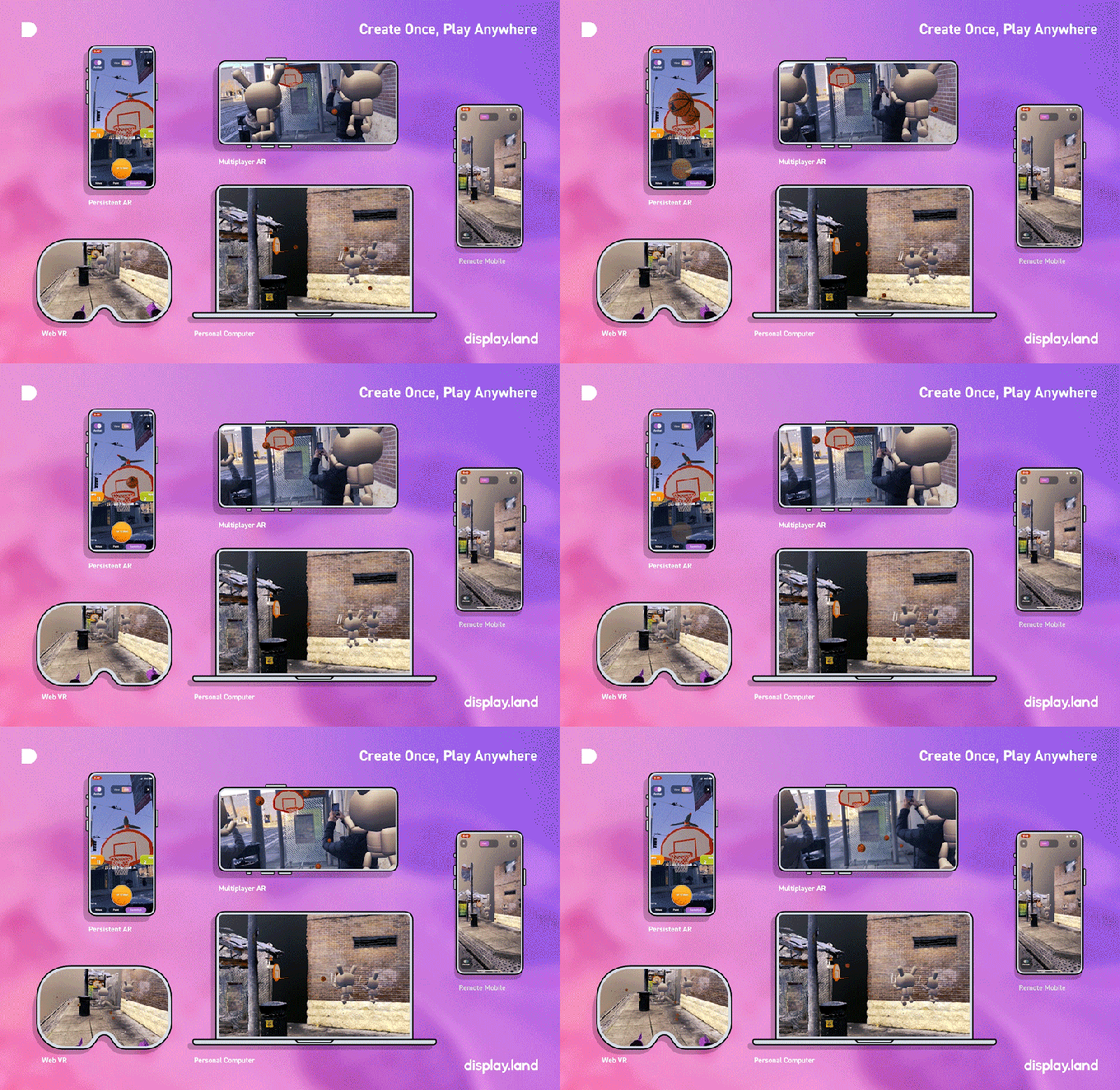
After a couple of public demos, including a showing at SFMOMA, Ubiquity6 released their app Display.land in public beta last month. The app enables users to walk through and capture 3D space with their phone cameras.

The company’s big announcement today puts that release in greater context; they’re building a level editor of sorts that can help developers and the technically curious turn their scans into small games or 3D scenes that mix the digital and real. Ubiquity6 is opening early access sign-ups for the studio editor today.

Ubiquity6 wants to seize on some of the consumer interest in real-time editors built for titles like Fortnite and Roblox that have become a hit with modders. Combining that kind of user experience with the niche of real-world capture that appeals to AR/VR junkies, the company is hoping they can bring aboard a community that understands what their platform could enable.

Display.land may be built with the phone in mind, but Ubiquity6 hopes that the startup’s phone app will be a means to an end for creators capturing and designing 3D content that can be viewed on multiple platforms via the web. I demoed the company’s platform on mobile, desktop and VR, something that just required clicking a link. The app still feels quite experimental and there’s a non-trivial learning curve to capturing environments that won’t turn out as a gargled 3D mess.

“The thing about this age of creativity is that you never know what’s good enough,” Midha tells TechCrunch in an interview. “It will not work in 100% of examples, but ‘good enough’ really only comes from giving it to a large number of users and seeing where they find it useful.”

The startup’s product is in its early stages while engines like Unity are behemoths built for plenty of use cases. As Unity optimizes for professional use cases beyond gaming, it’s too complex and time-intensive to keep up with developers, Midha argues. Over time, he says, the company’s platform will pick up more general purpose functionality to appease developers that are interested in elements of this new offering but desire more base level features to compete with existing engines.

While other AR startups have drifted away from consumers to find more receptive enterprise customers, Midha feels that the consumer opportunity hasn’t been tapped. “I think the vision has always been consumer,” he says. “If you believe and have conviction in the space, it’s unfair to compromise on that vision.


from TechCrunch https://ift.tt/30jma5f
via IFTTT

viernes, 10 de enero de 2020

Alphabet’s controversial chief legal officer David Drummond is leaving, saying he has decided to retire

The changing of the guard at Alphabet continues. Roughly one month after Google founders Larry Page and Sergey Brin announced they’d be stepping down as the CEO and president of the search giant’s parent company, one of their top lieutenants, Alphabet’s chief legal officer, David Drummond, told employees that he, too, is leaving the company.

In a memo shared with Bloomberg and reprinted below, Drummond said that “with Larry and Sergey now leaving their executive roles at Alphabet” and the company “entering an exciting new phase,” he is, after “careful consideration,” retiring “to make way for the next generation of leaders.”

His departure can’t surprise many in Silicon Valley. In November, Alphabet’s board of directors opened an investigation into how executives at the company have handled misconduct claims, forming both an independent subcommittee and hiring a law firm to look into the issues. Presumably, much of their attention was focused on Drummond, whose long-ago extramarital affair with one employee with whom he shares a child first surfaced in a story by The Information in 2017, and who more recently married another employee from Google’s legal department.

Though Alphabet has long supported Drummond — he helped incorporate the company when it was founded in 1998 and remained one of its top executives — the corporate giant came under pressure to do something after Drummond’s earlier affair began to garner unwanted attention. Specifically, the former employee with whom he shares a child, Jennifer Blakely, published a post on Medium last summer in which she described Drummond as a serial philanderer who left his wife for her, then left her and the son that he fathered with her for another now-former Google employee.

Blakely also claimed Drummond had had “an affair with his ‘personal assistant’ who he moved into one of his new homes.”

One day later, Drummond issued a statement of his own, acknowledging his relationship with Blakely and their “difficult break-up 10 years ago.” He went on to state that, “Other than Jennifer, I never started a relationship with anyone else who was working at Google or Alphabet. Any suggestion otherwise is simply untrue.”

Days after issuing the statement, Drummond married a Google employee he’d been dating.

Drummond made a substantial fortune throughout the course of his career with Google, then Alphabet. He was paid $47 million last year. According to stock filings tracked by CNBC, he also sold $77 million worth of stock earlier this month, following sales of more than $70 million in November and again in December, just before Page and Brin said they were departing their roles. They remain on the board of Alphabet. Drummond’s last day with the company will be January 31.

His note to employees follows:

More than 20 years ago, Larry Page and Sergey Brin first asked me to help them with their unincorporated startup. Of course, that startup would grow to include more than 100,000 employees and make a positive impact on the lives of people around the world. From the beginning, I felt privileged to work with Larry and Sergey to realize their commitment to making information more universally accessible and useful, and was thrilled to join Google full-time in 2002.

With Larry and Sergey now leaving their executive roles at Alphabet, the company is entering an exciting new phase, and I believe that it’s also the right time for me to make way for the next generation of leaders. As a result, after careful consideration, I have decided to retire at the end of this month.

As I do so, I’d like to thank everyone with whom I’ve had the privilege to work so closely over the past two decades. Whether we were fighting alongside others around the globe to protect and expand freedom of expression; pressing to make sure copyright law continued to foster openness and creativity; designing an unconventional but dynamic corporate structure that has served Google so well; putting together industry-changing acquisitions that served as the foundation for some of Google’s most popular products; creating and evolving the rules that protect our users; or establishing start-up models to help unleash the potential of our amazing Other Bets: I have always relished the opportunity to work with such talented colleagues.

In particular, I have loved building and being a part of the legal team: your dedication, drive and leadership in helping digital innovation flourish has been amazing to behold. I have also been energized and deeply impressed by my time with the corporate development, public policy, trust and safety and communications teams, as well as the folks at GV, Capital G and Jigsaw. These groups’ relentless creativity and herculean efforts to further Google’s ambitious mission have been beyond inspiring. I’d also like to thank BGN and all of the company’s employee resource groups, whose tireless efforts continue to make the company better.

I know this company is in the best of hands, and I am excited for what the future holds for Google, for Alphabet and for me. But, as I move on, I’d like to thank Larry and Sergey and each and every one of you for providing me with the most engaging, challenging and rewarding professional environment that anyone could hope for. I am deeply grateful.


from TechCrunch https://ift.tt/36FyWgM
via IFTTT

martes, 7 de enero de 2020

Mercedes-Benz and James Cameron built an Avatar-inspired car perfect for Pandora

Mercedes-Benz channeled the wild and imaginative world of James Cameron’s hit movie Avatar for its latest concept car — an electric autonomous vehicle covered in bionic flaps that aims to show how man and machine can merge and live responsibly in nature.

The concept car, appropriately named AVTR for Advanced Vehicle Transformation, was unveiled Monday night at CES 2020, the giant tech trade show held each year in Las Vegas. And like many concept cars, it’s outrageous and sleek and a little bit out there. Did we mention it has scales?

To be clear, this is a show car. This means the Vision AVTR won’t be available to buy now, next year or in five.  But as Ola Källenius, Daimler’s Chairman and the head of Mercedes-Benz noted Monday night, “show cars are here to spark our imagination, just like science fiction movies do.”

The idea is that these exercises conducted periodically by automakers not only spark creativity among engineers and designers, it can also telegraph where they’re headed. For Mercedes, the big message that Källenius was pushing Monday evening during his CES 2020 keynote was sustainability throughout the entire life cycle of a vehicle from the plant it is built in to materials used in the battery.

And this is indeed a goal within Mercedes-Benz.

The concept car has no steering wheel or pedals because it’s theoretically autonomous. The interior is completely vegan and it has a wide sweeping display that seems to cover and curve over the entire front dash. But that’s not the wild part.

Once sitting inside the user can control the vehicle by touching the center console. The car then comes to life and can recognize the driver’s pulse and breath. From here, the driver can lift there hand, turn their palm towards a projected light. The driver picks the projected icon they want, squeezes their hand shut and the off the car goes — again theoretically.

The vehicle is made of sustainability materials all the way down to the organic battery made from recyclable materials, which are compostable and recyclable.

The 33 multi-directionally movable surface elements on the back of the vehicle act as bionic flaps and are
reminiscent of scales of reptiles. Speaking of animals, the AVTR can move sideways by 30 degrees in a “crab movement” that gives it maximum agility.


from TechCrunch https://ift.tt/2s5Qrb2
via IFTTT

domingo, 5 de enero de 2020

The future (and past) of mobile gaming

The summer of 2008 changed everything.

Apple’s launch of the App Store a year after the release of the iPhone was a watershed moment not only in the business of technology, but in every aspect of humanity. Nearly every industry can look back at data before July 2008 and after and see how rapidly and profoundly things changed. But one sector in particular turned into a completely different beast.

Gaming.

We’ve seen some amazing firms come out of the mobile gaming space, some with more success than others. One gaming founder who experienced the full gamut of entrepreneurial emotion is Thor Fridriksson, founder of QuizUp. As we head into 2020, I hopped on the phone with him to discuss the rapid rise of QuizUp in the early oughts, its hard fall from grace following a botched deal with NBC and Fridriksson’s predictions about the next decade of mobile gaming.

(This interview has been edited for length and clarity. Emphasis is mine.)

Jordan Crook: Can you believe it’s almost 2020? Doesn’t feel real.

Thor Fridikksson: I remember when I was teenager. I was into role playing games like the typical nerds. One of the ones I loved the most was called Cyberpunk 2020. It was set in 2020, and it was all about bionic arms and implants and very, very futuristic stuff. And this is kind of why 2020 has a special meaning to me. But, usually, when people predict the future, they’re always so far off. It’s almost unbelievable.

Yeah, we haven’t quite gotten that that down yet, have we? Really being good at predicting the future. Maybe this next decade, with the era of big data, will change that. But let’s focus on the past for a bit. Take me 10 years back. I want to hear about how QuizUp became the popular game it was. You guys reached 20 million users in the first 12 months.

At the beginning of the decade, I was just graduating from university. I had lived in Iceland all my life, but for my MBA I moved to the UK to attend Oxford. It was a pretty wild time for me, especially because Oxford University had this annual thing called ‘Silicon Valley Comes to Oxford.’ I was watching this whole smartphone revolution that was just taking place.

We had the privilege of getting some really top entrepreneurs from the Valley at Oxford and they actually spent a whole week with students in the MBA program. People like Reid Hoffman, the founder of LinkedIn, and Biz Stone, one of the founders of Twitter, and others. I volunteered to be a tour guide for them.

And it was just fantastic! It was fantastic to be having dinners with these entrepreneurs from this totally different kind of environment in Silicon Valley. The environment for the U.S. entrepreneur is so much different from the European, in many ways. U.S. entrepreneurs have this kind of boldness, this fearlessness. Their feelings about failure were something that I was fascinated by.

At later stages, I would have to experience this myself. Personally, I think that one of the things that the U.S. entrepreneurial ecosystem gets right is that the stigma of starting a business and failing one is not nearly as strong as it is in Europe. If you start the business in Europe and you somehow fail, you will not have any chance to … it’s like, you’re an immediate loser. Whereas the thinking, or how people perceive entrepreneurs in the U.S., is that they’re those guys that try and try and try again. This is such a big difference in mentality between the two continents, and this is one big advantage that the U.S. has.


Fridriksson returned to Iceland after graduating Oxford during one of the biggest economic collapses in the world, which hit Iceland particularly hard. “There was absolutely nothing for a newly graduated business guy to do,” he said. This is around the time he started Plain Vanilla, which would be the parent company of QuizUp. He completely focused on the Icelandic market, unconcerned with the U.S., after having seen the smartphone unlock various geographies.

The first game out of Plain Vanilla wasn’t a trivia game at all. It was actually a children’s game called The Moogies that Fridriksson spent 18 months designing and producing. He recalls it as the classic founder story — he sold all of his stuff, spent all of his money and took out a bunch of loans to fund the project. “I wasn’t really thinking about VCs or anything like that, especially because there weren’t any here in Iceland at the time,” said Fridriksson.

In 2011, Plain Vanilla launched the Moogies, a sort of interactive, cartoon-based game for kids.


It was a massive failure. It’s one of those moments in life where you just put your heart and soul into something. I will always remember this moment. It was a pivotal moment before I started QuizUp. We were working with this big publisher, and I was waiting to see the first sales numbers for the game after it launched.

It was a big thing in Iceland. I was in the press and doing interviews and the launch of the game was big news in Iceland because we’re such a small country. I was really excited and I was thinking, ‘I hope it’s going to be 500,000 downloads, but 100,000 would be great. 50,000 would be OK.’ I was refreshing the dashboard and when I finally saw the number, it was only 500 units sold. Immediately, in one heartbeat, I knew that one and a half years of hard labor was down the drain.

What do you think went wrong there? Did you spend too much time building it out without an MVP or a beta? Do you think it would have done better if you shipped something a bit more bare bones earlier?

I don’t think that was what I did wrong. Actually, I’m a big believer in polish. Especially when it comes to games, I don’t think you should just try to get something out to prove something. You should really, in all your products, think about the details and offer a more finished product than an MVP.

In the case of the Moogies, it was a paid app. This is just around the time when free-to-play and the freemium economy was starting. So, paid apps just did significantly worse. The reason I wanted it to be paid is because I didn’t like advertising, especially not in children’s apps. I was against in-app purchases at the time and advertising, and I just wanted to create a very safe and nice experience for young children. I had my own toddler at the time who was the Chief Tester of the game.

So, it was a paid app. But the other issue is that breaking into the children’s category is so tough. They are probably the most brand loyal audience you will ever find. And I’m not really talking about the kids, I’m talking about their parents. When you have a kid that likes a certain theme of toy, like Mickey Mouse or whatever it is, their parents will only buy that. It’s very hard to get any sort of virality or break into children’s brands without mainstream marketing money.

Was the Moogies the only game Plain Vanilla launched before QuizUp?

Well, I get this idea of QuizUp. It’s a dark winter night in Iceland. I had just realized that I was bankrupt. And there was no way for me to get any more funding from Iceland. I was really feeling, what I mentioned before, this scorn. I would go to see investors and they’d ask how Moogies went, and I would tell them and try to make it look prettier than it was. They would block me immediately because there is this stigma of failure. And this is when I really felt that being in Europe, and having failed on my first try… it really damages your chances of getting up again.

I get this idea for QuizUp and write it on this electric bill that I can’t pay. And I was just convinced. I get this really strong feeling that this game would be the formula to virality and success. Users would play real people in real time and they would have all these rankings and titles. People are so vain, in general, that I knew they would just love it. It felt like something that hadn’t been done before and I really wanted to do it.

But, again, I had no money. I was totally bankrupt and had no employees anymore. But I remembered those guys from Oxford, Reid Hoffman and Biz Stone, and I think to myself, ‘I’m so connected. I’ll just go there. I’m 100 percent sure that with this great idea, these VCs will just throw money at me. I’ll be able to do this. Easy Peasy.’


Fridriksson hired two engineers on the promise of getting to move to San Francisco and help on the project. The plan was for the engineers to build a prototype of QuizUp while Fridriksson went around to VCs trying to secure seed funding. They all lived in a small apartment together.


This plan was a bit naive, when I look back at that time. I was expecting a red carpet to be waiting for me. That, when I arrived in San Francisco, people would be throwing money at me. And it was actually quite the opposite. Getting seed funding with just an idea is quite hard.

So did you get the funding?


from TechCrunch https://ift.tt/35urvr3
via IFTTT

viernes, 3 de enero de 2020

Adobe CTO says AI will ‘democratize’ creative tools

Adobe CTO Abhay Parasnis sees a shift happening.

A shift in how people share content and who wants to use creative tools. A shift in how users expect these tools to work — especially how much time they take to learn and how quickly they get things done.

I spoke with Parasnis in December to learn more about where Adobe’s products are going and how they’ll get there — even if it means rethinking how it all works today.

“What could we build that makes today’s Photoshop, or today’s Premiere, or today’s Illustrator look irrelevant five years from now?” he asked.

In many cases, that means a lot more artificial intelligence; AI to flatten the learning curve, allowing the user to command apps like Photoshop not only by digging through menus, but by literally telling Photoshop what they want done (as in, with their voice). AI to better understand what the user is doing, helping to eliminate mundane or repetitive tasks. AI to, as Parasnis puts it, “democratize” Adobe’s products.

We’ve seen some hints of this already. Back in November, Adobe announced Photoshop Camera, a free iOS/Android app that repurposes the Photoshop engine into a lightweight but AI-heavy interface that allows for fancy filters and complex effects with minimal effort or learning required of the user. I see it as Adobe’s way of acknowledging (flexing on?) the Snapchats and Instas of the world, saying “oh, don’t worry, we can do that too.”

But the efforts to let AI do more and more of the heavy lifting won’t stop with free apps.

“We think AI has the potential to dramatically reduce the learning curve and make people productive — not at the edges, but 10x, 100x improvement in productivity,” said Parasnis.

“The last decade or two decades of creativity were limited to professionals, people who really were high-end animators, high-end designers… why isn’t it for every student or every consumer that has a story to tell? They shouldn’t be locked out of these powerful tools only because they’re either costly, or they are more complex to learn. We can democratize that by simplifying the workflow.”


from TechCrunch https://ift.tt/2MPCtkA
via IFTTT