viernes, 5 de febrero de 2021

Extra Crunch roundup: 500 Startups’ demo day, smart SaaS pricing and much more

Demo days at startup accelerators are a pretty big deal around here.

These events aren’t just a chance to review the latest cohort of hopeful entrepreneurs — they also showcase the technology, products and services that will compete for VC and consumer attention over the next few years.

You never know where a hit will come from, which is why these events capture our attention. Here’s just one example from Y Combinator’s Summer 2013 Demo Day:

Positioning itself as the “FedEx of today,” it hopes to provide a logistics framework that goes beyond food and can be used for any type of on-demand order.

That startup was DoorDash, by the way.


Full Extra Crunch articles are only available to members
Use discount code ECFriday to save 20% off a one- or two-year subscription


Full disclosure: In 2016, I was 500 Startups’ Journalist-in-residence. I covered one demo day in person, spending most of my time backstage where founder teams practiced their pitches.

It was quite a scene: Several people literally jumped up and down to shake off their nervous energy, but I also recall one who calmly recited their lines while gazing through a window.

Yesterday, Jon Shieber and Alex Wilhelm covered 500 Startups’ 27th virtual demo day and selected eight companies as their favorites:

  • Stack
  • Adapty
  • MightyFly
  • Omnitron Sensors
  • AWSM
  • Memechat
  • Ryu Games
  • Apothecary

Thank you very much for reading Extra Crunch this week! I hope you have a safe, relaxing weekend.

Walter Thompson
Senior Editor, TechCrunch
@yourprotagonist

TechCrunch’s favorite companies from 500 Startups’ latest demo day

Chick hatching from egg on egg tray

Image Credits: David Malan (opens in a new window) / Getty Images

How the GameStop stonkathon helped Robinhood raise $3.4B last week

I’ve never used “stonkathon” in a headline before, but it’s been that kind of week.

The war between hedge funds and day traders over GameStop vaulted discount trader Robinhood into the headlines for days.

But how did it affect the company’s financial health?

This morning, Alex Wilhelm examined why Robinhood’s investors were willing to inject $3.4 billion more into the company in just one week.

“More trades means more PFOF (payment for order flow) revenue,” says Alex. “And Robinhood effectively doubled in size.”

Udemy’s new president discusses the reskilling company’s future

Electronic signature on laptop. Business Esignature technology, digital form attached to electronically transmitted document, verification of intent to sign agreement, legal deal. Vector illustration

Image Credits: Andrew_Rybalko / Getty Images

Reporter Natasha Mascarenhas interviewed Greg Brown, new president of digital learning platform Udemy, after his company announced that it surpassed $100 million ARR.

A new arm of the company, Udemy for Business, just secured a 100,000-employee contract with Cisco Systems to offer software, business and technology courses.

“The opportunity that the company sees has really forced us to reallocate resources and strategy,” said Brown.

Why one Databricks investor thinks the company may be undervalued

After scaling its ARR to $425 million and reaching a valuation of $28 billion, data analytics company Databricks is clearly IPO-ready.

Battery Ventures has backed Databricks since 2017, so Alex Wilhelm interviewed General Partner Dharmesh Thakker to understand why he thinks the company may be undervalued.

“Whether it’s digital transformation, whether it’s analytics, data is everywhere,” said Thakker. “So the TAM is massive.”

4 strategies for deep tech founders who are fundraising

Laser Light Interrupted by Unfolded Book Shape of Paper.

Image Credits: MirageC (opens in a new window) / Getty Images

Deep tech founders face special challenges when pitching investors: they usually don’t have a product, customers or revenue.

It’s difficult enough to ask a stranger for a check when there’s a beta product, but how do you drum up interest in an unproven idea that may exist largely in your imagination?

“Early-stage investors are in the business of funding dreams,” says angel investor Jessica Li.

“Investors are less interested in the intricacies of your technology and more interested in what impact it can create.”

Step one: use storytelling to highlight your big vision.

Edtech valuations aren’t skyrocketing, but investors see more exit opportunities

Above view of mom working on the laptop computer while her daughter reading the e-learning resources on the digital tablet in the workspace at home

Image Credits: Images by Tang Ming Tung (opens in a new window) / Getty Images

Investors funded edtech startups with $10 billion last year as the pandemic forced widespread adoption of remote learning.

The valuations of these companies aren’t rising at the same rate as SaaS or fintech startups, but “where edtech lacks in impressive valuations, investors see it gaining in exit opportunities,” writes Natasha Mascarenhas.

For this edtech investor survey, she interviewed:

  • Deborah Quazzo, managing partner, GSV Ventures (an education fund backing ClassDojo, Degreed and Clever)
  • Ashley Bittner, founding partner, Firework Ventures (a future-of-work fund with portfolio companies LearnIn and TransfrVR)
  • Jomayra Herrera, principal, Cowboy Ventures (a generalist fund with portfolio companies Hone and Guild Education)
  • John Danner, managing partner, Dunce Capital (an edtech and future-of-work fund with portfolio companies Lambda School and Outschool)
  • Mercedes Bent and Bradley Twohig, partners, Lightspeed Venture Partners (a multistage generalist fund with investments including Forage, Clever and Outschool)
  • Ian Chiu, managing director, Owl Ventures (a large edtech-focused fund backing highly valued companies including BYJU’s, Newsela and MasterClass)
  • Jan Lynn-Matern, founder and partner, Emerge Education (a leading edtech seed fund in Europe with portfolio companies like Aula, Unibuddy and BibliU)
  • Benoit Wirz, partner, Brighteye Ventures (an active edtech-focused venture capital fund in Europe that backs YouSchool, Lightneer and Aula)
  • Charles Birnbaum, partner, Bessemer Venture Partners (a generalist fund with portfolio companies including Guild Education and Brightwheel)
  • Daniel Pianko, co-founder and managing director, University Ventures (a higher-ed and future-of-work fund that is backing Imbellus and AdmitHub)
  • Rebecca Kaden, managing partner, Union Square Ventures (a generalist fund with portfolio companies including TopHat, Quizlet and Duolingo)
  • Andreata Muforo, partner, TLcom Capital (a generalist fund backing uLesson)

Deep Science: AIs with high class and higher altitudes

Artificial Intelligence digital concept

Image Credits: MF3d (opens in a new window) / Getty Images

In his latest recap of recent breakthroughs in applied science, Devin Coldewey looked at how researchers are using AI to:

  • Categorize thousands of pieces of classical music
  • Read MRIs to spot patients with schizophrenia
  • Track elephant herds via satellite
  • Improve accessibility on mobile phones

Spotify Group Session UX teardown: the fails and their fixes

London, UK - July 31, 2018: The buttons of the music streaming app Spotify, surrounded by Podcasts, Apple Music, Facebook and other apps on the screen of an iPhone.

Image Credits: Getty Images

In the latest of a series of articles that examines user experiences for consumer apps, UX expert Peter Ramsey and TechCrunch reporter Steve O’Hear studied Spotify Group Session, the shared-queue feature that permits users to create playlists collaboratively.

“Many of these lessons can be applied to other existing digital products or ones you are currently building,” such as the need to add context for important decisions and how to best use “react and explain” prompts.

Lightspeed’s Gaurav Gupta and Grafana’s Raj Dutt discuss pitch decks, pricing and how to nail the narrative

Gaurav Gupta, Lightspeed Venture Partners + Raj Dutt, Grafana Labs

Extra Crunch Live returned this week with two guests: Lightspeed Venture Partners’ Gaurav Gupta and Raj Dutt, co-founder and CEO of Grafana Labs.

In addition to walking us through the presentation that encouraged Lightspeed to invest in Grafana’s Series A, the duo also gave direct feedback to audience members about their pitch decks.

Watch a video with our complete episode, or read highlights from the chat to get Gupta and Dutt’s insights on what goes into a successful pitch deck.

New episodes of Extra Crunch Live drop each Wednesday at 12 p.m. PST/3 p.m. EST/8 p.m. GMT.

Here’s a breakdown of the complete episode with Gaurav Gupta and Raj Dutt:

  • How they met — 2:00
  • Grafana’s early pitch deck — 12:00
  • The enterprise ecosystem — 25:00
  • The pitch deck teardown — 32:00

Subscription-based pricing is dead: Smart SaaS companies are shifting to usage-based models

paper plane made from a ten dollar bill

Paper plane made from a ten-dollar bill. Image Credits: LockieCurrie (opens in a new window)/ Getty Images

Some IT managers may still be debating the merits of usage-based pricing versus subscription-based models, but SaaS investors have made up their minds.

Compared to their rivals, companies that employ usage-based pricing trade at a 50% revenue multiple premium. You can argue with success, but seven out of the nine IPOs since 2018 with the best net dollar retention offer usage-based models.

If you’re a founder who hopes to break into the $100M ARR club, this guest post can help you identify the right usage metrics for creating a sustainable customer journey.

For more actionable advice regarding SaaS pricing and sales, see these previously published Extra Crunch stories:

Bumble IPO could raise more than $1B for dating service

How many dating networks can the public market support?

In Tuesday’s column, Alex Wilhelm examined the latest IPO filing from relationship-finding service Bumble.

The company set a range of $28 – $30 per share, so Alex set out to find its simple and diluted valuations, how much it expects investors to pay and “how those stack up compared to Match Group’s own numbers.”

Robinhood’s Q4 2020 revenue shows a return to growth

Discount brokerage Robinhood stayed in the news last week as it became a proxy battlefield for institutional and retail investors, but its backers “put in another billion just last week,” says Alex Wilhelm.

Why were investors so bullish after days of screaming headlines?

In yesterday’s column, Alex unpacked Robinhood’s Q4 2020 numbers, “which shows a return to sequential-quarterly growth at the trading upstart.”

Trading app Public drops payment for order flow in favor of tips

close up of man hand with digital tablet analyzing stock market graph at night

Image Credits: Towfiqu Photography / Getty Images

Before Redditors came after GameStop, zero-cost trading service Public says it was seeing “steady ~30%” month-over-month growth.

Last week, however, “new user signups went up 20x,” founders Leif Abraham and Jannick Malling told TechCrunch.

After closing a $65 million Series C, Public announced yesterday that it would “stop participating in the practice of Payment for Order Flow,” replacing PFOF with an “optional tipping feature.”

Customer advisory boards are a gold mine for startup brand champions

People figures with comment clouds above their heads. Commenting on feedback, participation in discussion. Brainstorming, fresh new ideas. Communication in civil society. Cooperation and Collaboration (People figures with comment clouds above their he

Image Credits: Andrii Yalanskyi (opens in a new window) / Getty Images

Startups that don’t directly engage their earliest customers with purpose and intention are leaving money on the table.

Creating a Customer Advisory Board (CAB) is a proven method for soliciting product ideas, testing marketing plans and turning early users into loyal brand advocates.

Before you call a CAB, read this post to find out how to identify customers who’ll contribute real insights, establish goals and “pick members who play well together.”

Best practices as a service is a key investment theme to watch in 2021

Red and white stop sign on the wall. Image Credits: Karl Tapales (opens in a new window)/ Getty Images

Identity and access management company Okta announced in a study last week that its largest customers use an average of 175 different applications to manage their operations.

Managing Editor Danny Crichton says this “explosion of creativity and expressiveness and operational latitude” offers widespread benefits, but it’s “also a recipe for disaster,” since many end users aren’t well-trained when it comes to using these tools.

This enterprise version of the Tower of Babel creates an opening for companies that offer “best practices as a service,” says Danny. “The next generation of SaaS software has to take those abecedarian building blocks and forcibly guide users to using those tools in the best possible way.”


from TechCrunch https://ift.tt/2YMRQjt
via IFTTT

jueves, 4 de febrero de 2021

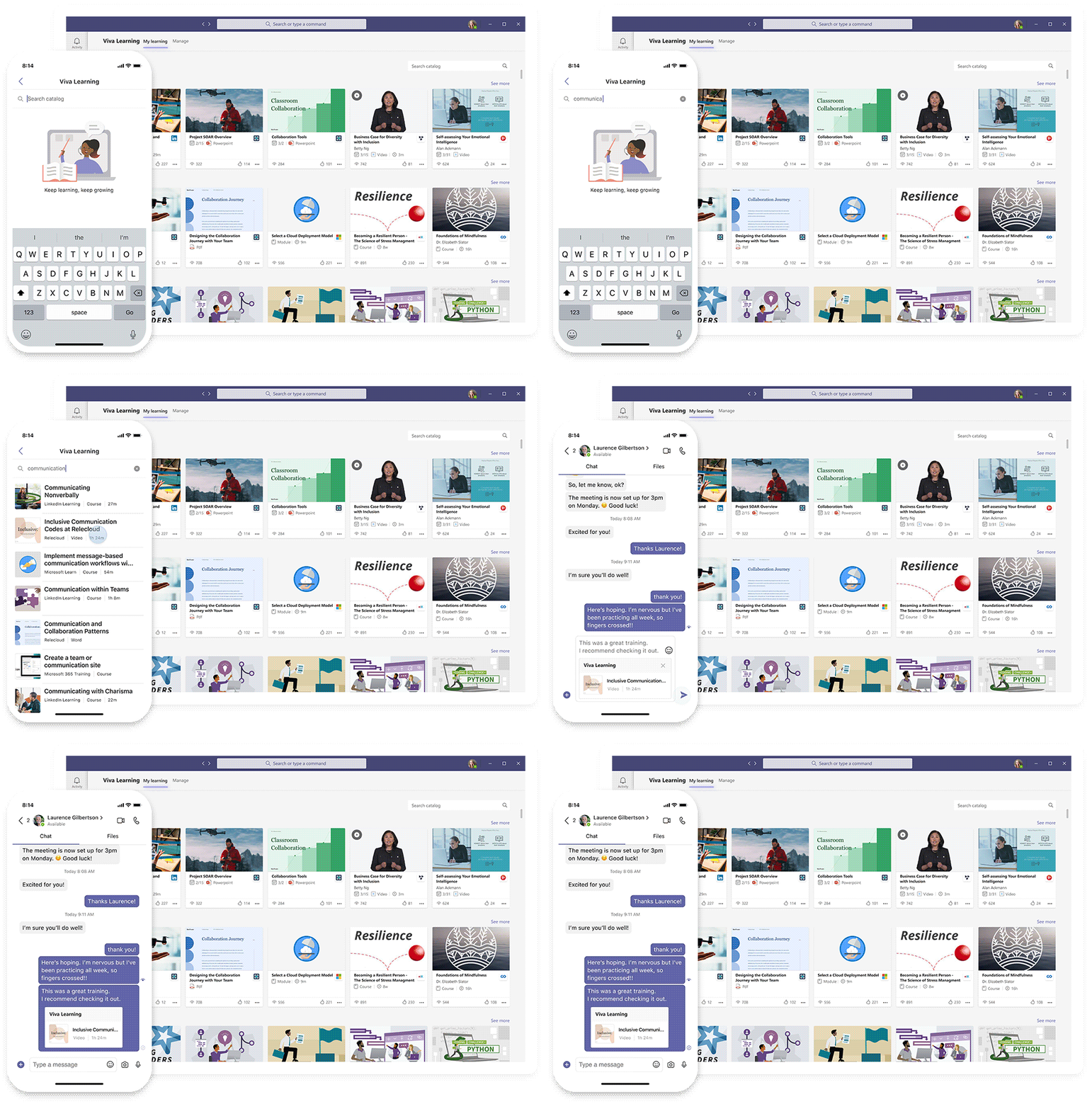
Microsoft launches Viva, its new take on the old intranet

Microsoft today launched Viva, a new “employee experience platform,” or, in non-marketing terms, its new take on the intranet sites most large companies tend to offer their employees. This includes standard features like access to internal communications built on integrations with SharePoint, Yammer and other Microsoft tools. In addition, Viva also offers access to team analytics and an integration with LinkedIn Learning and other training content providers (including the likes of SAP SuccessFactors), as well as what Microsoft calls Viva Topics for knowledge sharing within a company.

If you’re like most employees, you know that your company spends a lot of money on internal communications and its accompanying intranet offerings — and you then promptly ignore that in order to get actual work done. But Microsoft argues that times are changing, as remote work is here to stay for many companies, even after the pandemic (hopefully) ends. Even if a small percentage of a company’s workforce remains remote or opts for a hybrid approach, those workers still need to have access to the right tools and feel like they are part of the company.

Image Credits: Microsoft

“We have participated in the largest at-scale remote work experiment the world has seen and it has had a dramatic impact on the employee experience,” Microsoft CEO Satya Nadella said in a pre-recorded video. “As the world recovers, there is no going back. Flexibility in when, where and how we work will be key.”

He argues that every organization will require a unified employee experience platform that supports workers from their onboarding process to collaborating with their colleagues and continuing their education within the company. Yet as employees work remotely, companies are now struggling to keep their internal culture and foster community among employees. Viva aims to fix this.

Unsurprisingly, Viva is powered by Microsoft 365 and all of the tools that come with that, as well as integrations with Microsoft Teams, the company’s flagship collaboration service, and even Yammer, the employee communication tool it acquired back in 2012 and continues to support.

There are several parts to Viva: Viva Connections for accessing company news, policies, benefits and internal communities (powered by Yammer); Viva Learning for, you guessed it, accessing learning resources; and Viva Topics, the service’s take on company-wide knowledge sharing. For the most part, that’s all standard fair in any modern intranet, whether it’s from a startup provider or an established player like Jive.

Viva Insights feels like the odd one out here, especially after Microsoft’s kerfuffle around its Productivity Score. The idea here is to give managers insights into whether their team (but not individual team members) are at risk of burnout, for example, in order to encourage them to turn off notifications or set daily priorities (a good manager, I’d hope, could do this without analytics, but here we are, in 2021). It’s also meant to help company leaders “address complex challenges and respond to change by shedding light on organizational work patterns and trends.” Sure.

Because this is Microsoft in 2021, there’s also a lot of talk about employee well-being in today’s announcement. For most employees, that means fewer meetings, more focus time and turning off notifications after work. Obviously there are technical tools to help with that, but it’s really a question of company culture and management. I’m not sure you need analytics integrated with LinkedIn’s Glint for that, but you can now have those, too.

“As the world of work changes, the next horizon of innovation will come from a focus on creativity, engagement and well-being so organizations can build cultures of resilience and ingenuity,” said Jared Spataro, corporate vice president, Microsoft 365. “Our vision is to deliver a platform for the employee experience that helps organizations create a thriving culture with engaged employees and inspiring leaders.”


from TechCrunch https://ift.tt/2O9M0qp
via IFTTT

miércoles, 3 de febrero de 2021

Box acquires eSignature startup SignRequest for new content workflows

Box announced this morning that it has agreed to acquire eSignature startup SignRequest for $55 million.The acquisition gives the company a native signature component it has been lacking and opens up new workflows for the company.

Box CEO Aaron Levie says the company has seen increased demand from customers to digitize more of their workflows, and this acquisition is about giving them a signature component right inside Box that will be known as Box Sign moving forward. “With Box Sign, customers can have a seamless esignature experience right where their content already lives,” Levie told me.

While Box has partnerships with other eSignature vendors, this gives it one to call its own, one that will be built into Box starting this summer. As we have learned during this pandemic, the more work we can do remotely, the safer it is. Even after the pandemic ends and we get back to more face-to-face interactions, being able to do things fully in the cloud and removing paper from the workflow will speed up everything.

“The massive push to remote work effectively instantly highlighted for every enterprise where their digital workflows were breaking down. And eSignature was a major part of that — too many industries still rely on paper based processes,” he said.

Levie says that the signature component has been a key missing piece from the platform. “As for our platform, when you look at Snowflake, they’re the data cloud. Salesforce is the sales cloud. Adobe is the marketing cloud. We want to build the content cloud. Imagine one platform that can power the entire lifecycle of content. eSignature has been a major missing link for critical workflows,” he said.

He believes this will open up the platform for a number of scenarios, that while possible before, could not flow as easily between Box components. “Having SignRequest gets us more natively into mission critical workflows like customer contracts, vendor onboarding, healthcare onboarding and supply chain collaboration,” Levie explained.

It’s worth noting that Dropbox acquired HelloSign for $230 million two years ago to provide it with a similar kind of functionality and workflow capability, but analyst Alan Pelz-Sharpe from Deep Analysis, a firm that follows the content management market, says this wasn’t really in reaction to that.

“I think what is interesting here is that Box is going to integrate SignRequest and bundle it as part of the standard service. That’s what really caught my eye as the challenge with eSig is that it’s typically a separate product and so gets limited use. They bought it partly in response to Dropbox, but it was a hole that needed fixing regardless so would have done so anyway,” Pelz-Sharpe explained.

As for SignRequest, the company was founded in the Netherlands in 2014. Neither Pitchbook nor Crunchbase has a record of it raising funds. The plan is for the company’s employees to join Box and help build the signature component that will become Box Sign. According to a message to customers on the company website, existing customers will have the opportunity over the next year to move to Box Sign, and get all of the other components of the Box platform.

Levie says the basic Box Sign function will be built into the platform at no additional charge, but there will be more advanced features coming that they could charge for. The deal is expected to close soon with the SignRequest team remaining in The Netherlands.


from TechCrunch https://ift.tt/2MRQHEk
via IFTTT

martes, 2 de febrero de 2021

Facebook Messenger lands on Oculus Quest

Facebook spent more time than usual talking about their success with VR in their quarterly earnings call, taking time to note developer success and their own wins peddling their latest Quest 2 VR headset.

One of the VR platform’s remaining quirks is a general lack of third-party support for apps that go beyond gaming. The headset is a powerful piece of hardware with few VR ports of mobile apps available, even available streaming apps from Hulu and Netflix have seen scant updates due to the relatively small number of headsets out there.

Facebook, a major app maker itself, has seemed to be playing a fairly delicate balancing act in bringing some of the mothership’s utility to the headset without alienating consumers who might be less interested in a clearly Facebook-branded piece of hardware. After mandating Facebook-login last fall it seems like most bets should be off there. Today, the company announced that Quest and Quest 2 users will now gain access to Messenger chats inside the app, enabling users to fire off a quick canned message to friends, use the in-VR keyboard to pound out a quick message, or use the headset’s voice-to-text feature.

For those upset about Facebook’s increasingly heavy-handed software presence on their VR platform, this will likely be another reason to avoid the Quest 2, but for those eager to make their VR gameplay a more social experience or avoid the total isolation that comes from strapping a headset on and ignoring your phone, it will be much more welcome.

Alongside, the Messenger update, Facebook also shared that with the new update, they will be rolling out what they call App Lab, essentially a TestFlight-like feature to allow Quest users to download content outside of the curated Oculus Store. It’s a feature meant to address develop complaints that Facebook has boxed fledgling game designers out from bringing content to the Quest. Users can search for the title by name in App Lab or click a link to be directed to the title. The new feature competed directly with SideQuest, a startup that has been building a hub for more experimental Quest content.

Facebook says that the new update is rolling out “gradually” to users so not all users may see the update immediately.


from TechCrunch https://ift.tt/3tnhUQj
via IFTTT

lunes, 1 de febrero de 2021

Best practices as a service is a key investment theme to watch in 2021

Enterprise IT has been completely transformed by SaaS the past decade. Okta last week published a report that showed that the largest companies now use 175 apps, a doubling over the past few years. More professionals have more tools to do their jobs than ever before. It’s an explosion of creativity and expressiveness and operational latitude — but also a recipe for disaster.

It’s one thing to give people and businesses tools — and something else to train them to use those tools effectively. Worse, as the number and complexity of software has skyrocketed the past decade, it’s only become harder for end users to grapple with offering their customers the best possible experience.

That’s the opportunity for a range of new tools that are designed to guide — sometimes forcefully — people to use the software they have in the best possible way, in what you might dub “best practices as a service.” It’s software that is opinionated on what “best” looks like within its domain, and ensures that as many people follow that model as possible with minimal dissension. It’s simplicity-in-a-box for a complex world.

Let me give some examples from a few major fields of startups in e-commerce, security, web development and finally, in my chosen profession, writing to illustrate what I mean.


from TechCrunch https://ift.tt/3tgNSgN
via IFTTT

Robotic process automation platform UiPath raises $750M at $35B valuation

UiPath, one of the leaders in the quickly growing robotic process automation (RPA) space, announced Monday that it has closed on $750 million in Series F funding at a staggering post-money valuation of $35 billion.

Existing backers Alkeon Capital and Coatue co-led the round, which also included participation from other returning investors such as Altimeter Capital, Dragoneer, IVP, Sequoia, Tiger Global, and funds and accounts advised by T. Rowe Price Associates, Inc. The financing brings the New York-based company’s total raised to nearly $2 billion since inception, according to Crunchbase.

UiPath was founded in 2005 but didn’t raise institutional capital until 2015, according to Crunchbase. CNBC reported in December that the company had annual revenue of about $360 million and over 6,300 customers including Amazon, Bank of America and Verizon.

UiPath’s self-proclaimed mission is “to unlock human creativity and ingenuity by enabling the Fully Automated Enterprise™ and empowering workers through automation.” Its Automation Platform aims to “transform the way humans work” by giving companies a way to build out and run automations across departments.

The company uses artificial intelligence (AI) and machine learning in an effort to “automate millions of repetitive, mind-numbing tasks for business and government organizations all over the world, improving productivity, customer experience and employee job satisfaction.” Its goal is to give workers the mental energy and time to focus on more complex jobs. Competitors include Microsoft Power Automate, Blue Prism, Automation Anywhere. SAP also recently entered the space.

The company has been growing like crazy. Back when I covered its $568 million Series D in April of 2019, UiPath had 400,000 users in 200 countries. At the time, the company said it had increased its annual recurring revenue (ARR) from $8 million in April 2017 to over $200 million. UiPath said then it had grown its headcount by 16 times over a two-year period, to more than 2,500 employees. It also hinted that it was considering an IPO.

True to its word, UiPath in December submitted a draft registration to the Securities and Exchange Commission for an initial public offering. So it’s especially interesting that it raised such a huge round now.

For some, UiPath’s going public could be the Snowflake IPO of 2021. Alternative payments provider Affirm followed a similar path recently – raising $500 million before filing for an IPO weeks later.

UiPath declined to comment on its latest funding round beyond a press release.


from TechCrunch https://ift.tt/3cvPRbp
via IFTTT