jueves, 26 de septiembre de 2019

YouTuber Caspar Lee co-founds Influencer marketing platform, raises £3M Series A

Despite the inexorable rise of social media influencers, several problems remain when it comes to brands trying to use these stars to push their products. The marketing tools and processes are fragmented (read: chaotic). Attaining some level of authenticity, quality and creativity in influencer-driven campaigns is tough, to say the least. And the whole thing has to look like the influencers are only promoting brands that they truly believe in, whether they are or not.

Perhaps that’s unkind? Some social influencers really do try and ‘curate’ the products they are charing to push. Plenty just do it only for the money, and it shows. The whole thing is largely a shitshow, to use a technical term. Some startups are trying to bring order to this tedious state of affairs.

Influencer, is a social media influencer marketing platform, which has now announced the close of a £3million (± $3.6million) Series A round led by Puma Private Equity.

Its platform claims to simplify the influencer marketing process for both advertisers and creators, giving advertisers access to a network of “macro and micro creators” pre-vetted for authenticity, quality and creativity based on first-party data. This unites “creator discovery, creator relationship management, campaign management and campaign reporting along with actionable insights” they say.

Key competitors include Whalar, Tribe, Takumi, Influential.co and FameBit.

But Influencer says it differentiates from these companies in that it puts a lot of the elements needed onto one platform for self-service and managed campaigns. It also has a white label solution.

Influencer has so far worked with brands including Boohoo, Alibaba, Pepsi, Starbucks, Pantene, Uber Eats, PrettyLittleThing and Apple Music, to get them in front of audiences via social media influencers.

The startup was launched in 2017 by 23 year old Ben Jeffries who leads the company as CEO, and 25 year old YouTuber and creator Caspar Lee.

It’s now brought on Adam Ludwin, co-founder of search intelligence company Captify and growth marketing agency Inflecto Media as Director of the Board.

The company will open its first US office in New York, led by CEO Ben Jeffries, with expansion planned to the West Coast over the next year.

It’s also released a mobile app, which “allows brands and content creators to create meaningful relationships claims Jeffries.

Caspar Lee says: “At Influencer we pride ourselves in being by creators, for creators, with a team who embody this new era of creativity and enjoy unrivaled relationships with the world’s leading creators.”


from TechCrunch https://ift.tt/2lhFUWG
via IFTTT

miércoles, 25 de septiembre de 2019

ZenBusiness raises $15m to help founders launch and grow “worry-free”

There are two sides to starting a new business. On one side, entrepreneurs need creativity, imagination — a dream, essentially — to find, build, and market a new product to users and consumers. But on the other side, they have to deal with the regulatory state and all the minutia that comes with running any business in the 21st century.

That includes such delightful topics as choosing a particular model for incorporation, ensuring that a business has the right licenses to operate, and tracking all the legal changes happening in 50 state legislatures every year. It can be inordinately complicated (and expensive!) to ensure that your business is ready and legal.

That’s where ZenBusiness comes in. The Austin-based startup wants to empower entrepreneurs to build businesses large and small by dramatically simplifying the processes required to launch a business and then grow it.

When I last chatted with the company 18 months ago, they had just raised a $4.5 million seed round and had launched its platform. Today, it’s announcing that it has raised a new $15 million series A round led by return backer Greycroft, along with returning investors Lerer Hippeau and Revolution’s Rise of the Rest fund, alongside new investors Rosecliff Venture Partners, Interlock Partners and Recruit Strategic Partners.

The company launched with a product that was essentially an automated registered agent for new entrepreneurs. Under state incorporation laws, companies must designate a so-called “registered agent” to receive official notices from regulatory agencies, and so ZenBusiness chose this strategic point for entry into the market.

When I last chatted with CEO Russ Buhrdorf, he described rolling up this market as one of the key initial targets for the company:

ZenBusiness is the brainchild of Ross Buhrdorf, who joined vacation rental marketplace HomeAway five months after its inception as founding CTO, and stayed for a decade until its acquisition by Expedia in 2015 for $3.9 billion. Buhrdorf intended to take a year off, but “didn’t quite make it a year” he told me.

He explained to me that HomeAway in many ways followed a rollup playbook, “raising $400 million and acquired 26 companies.” Bringing that rollup lens while exploring new spaces, he ran into the corporate legal services market, which offers help to companies to keep them in compliance with the law. Buhrdorf liked what he saw. “It’s different in all 50 states, highly-regulated, which is great for technology, it is overpriced, and they underserve their customers.” He says the space is “completely ripe for disruption.”

Since that time, the company has expanded its product to help entrepreneurs get beyond merely incorporating to actually building out their business by recommending services like banking, lending, tax preparation, website building, and more. The hope is to provide a “worry-free” guarantee to entrepreneurs so that they can get those early critical logistics out of the way and back to actually operating and growing their business.

“Small businesses come through this funnel, they don’t necessarily know exactly what to do. So we curate that solution, and then we provide them with the basics for them to get up and running and to be successful,” Buhrdorf said.

He explained that the company has built out some tools itself such as a simple webpage creator, but in the long run, he hopes to partner with other providers who integrate into the ZenBusiness platform. For instance, ZenBusiness has partnered with Xero as the company’s main accounting provider, while also backstopping that offering with accountants working at ZenBusiness. The idea is that the automated tooling plus a little human touch can help most owners handle the day-to-day challenges of running a business.

TeamPhoto2018

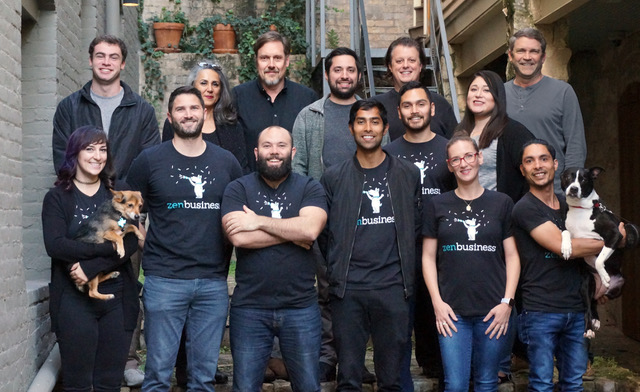
The ZenBusiness team in 2018. Photo via ZenBusiness.

Buhrdorf is particularly focused on keeping the product very self-service and automated to allow it to focus on these smaller customers. “Many of the companies that you cover that are in the enterprise space, who provide solutions for medium-sized businesses, they have to charge, they have to have sales forces, it’s very competitive there,” Buhrdorf said. “What we’re after is the segment that’s underserved, it’s the long tail of the small business segment.”

ZenBusiness has expanded its services, and it is hoping to use the fresh infusion of capital to invest in building out community features that will allow small business owners to swap tips with each other and help one another grow their businesses (presumably with some guidance from ZenBusiness community managers and experts).

The company is now 40 employees predominantly in Austin with a small office in Peru. Since we last checked in, the company has transitioned to become a public benefit corporation, which Buhrdorf said was an attempt to better align the company’s charter with its mission orientation to help small business entrepreneurs.

Update: The funding total was changed from $10m to $15m. Sorry about that.


from TechCrunch https://ift.tt/2n9HoTr
via IFTTT

martes, 24 de septiembre de 2019

Target Global is firming up its bet on Barcelona’s entrepreneurs

VC firm Target Global has just announced it’s expanding its European network by adding a local office in Barcelona, Spain — building on its existing presence in Berlin and London, plus Tel Aviv and Moscow.

The firm has €700 million under management and a broad investment range that covers SaaS, marketplaces, fintech and insurtech, as well as a big focus on mobility.

TechCrunch sat down with general partner Shmuel Chafets and investor director Lina Chong, who will be heading the firm’s push into Spain, to talk about its decision to set up shop in Barcelona — discussing how they see the local and national ecosystem, as well as picking their brains on wider investments trends and regulation in Europe.

Want to know what it takes to get a meeting with Target Global and factors they weigh when they’re deciding whether to cut a check or not? Read on…

The interview has been lightly edited for clarity. 


TechCrunch: Why choose Barcelona and why now? Why not Spain’s capital, Madrid — or even a city like Paris?

Shmuel Chafets: First of all have you been outside!?

I started coming to Barcelona four or five years ago just to see things and we had some angel investments here and it feels to me today — or when Lina and I started getting more serious about Barcelona it seemed to us that Barcelona has the attributes of Berlin eight or nine years ago. When I at least started coming to Berlin and Lina moved to Berlin, it has the same attributes. It looks like it’s just about to happen

I think it has a few factors. The first one is that it’s a great place to live and you can’t ignore that. In Europe, if you’re a team and you’re an international team there are very few places that you can live in. So London is the original ex-pat city of Europe and it still is amazing but very, very expensive. Berlin is the second one. And I think a lot of Berlin’s early success was fuelled by people who were not necessary German and definitely not Berliners coming and starting a company there.

It’s a good place to live, it’s also a cheap place to live, and it’s a cheap place to do business. Salaries here are quite low but the quality of living is quite high and that makes it very good for startups. Particularly when you need young people, developers, creative people to move. It’s an easy place to convince people to move to.

It doesn’t have a dominant industry. And that is very similar to Berlin — Berlin is not where Germany economically is, and that means that the smartest people around want to go in for startups. That’s the best employment option. There is no banking industry sucking people in with high salaries. And also driving costs up. It is in its culture a very creative city, a very open, very creative city and that I think is also very important.

And lastly, there are these early success stories that fuel the idea of entrepreneurship and also fuel financial entrepreneurship. So one of the interesting things about entrepreneurship is that people who start need to know where it ends or where it’s going to. And the early success stories — first of all they make the smartest kid graduating — who has a McKinsey job offer and a Goldman Sachs job offer and a startup idea — he needs to know that the startup idea has a future. That there’s a future in being an entrepreneur and he needs to look up to people around him. It’s not enough to know that Mark Zuckerberg dropped out — that’s fine but that’s very far and very large.

GettyImages 1147541590

Image via Getty Images / Pol Albarrán

But to look at Carlos [Pierre, founder and CEO] from Badi and say okay there’s a guy, he’s a few years older than me, he started a company, he’s doing very well — this is the path that I want to take.

Also, there are more and more mentors. People who’ve done it before. And they can help you figure things out. You have to be able to call someone up and say hey let’s have breakfast and explain how they do it.

And there’s more money — for seed. Because you look at a lot of people starting funds, and we were just talking on the way about the Ticketbis guys. They’re starting a fund. And that’s a great example of one of these early success stories and now they’re putting it back into the ecosystem and helping it grow.

Rocket Internet did a lot of that in Germany. They had early exits and then they went and plowed it all back into the ecosystem in their own particular way. People like [serial entrepreneur] Lukasz Gadowski — who we work with a lot. He built Spreadshirts… [then later] he founded Delivery Hero. So through Team Europe. So people who were early, early entrepreneurs — and then in the second wave helped build an ecosystem. So I think there are more and more people like that that we see here.

That usually fuels the ecosystem. Also as companies here start to scale and as more of these European startups start to build hubs here there’s more experience. You can find people who’ve been through a couple of rounds.

And the last thing which is not about Barcelona it’s about Spain in general. There’s a decent local domestic market and there is a natural second market in South America. And actually in the US too — because Spanish is the second most commonly spoken language in America so when you start a company here you have that second market built-in. Which is very important — you can scale it.

Latin America is a fascinating market right now, a fascinating time. So in a way, it’s a way for us to make a side bet on Latin America in a way without going out of Europe and insetting far. My first boss told me never to do business in a place where there’s no direct flight from where I live and I adhere to that. If things go belly up you don’t want to be stuck in transfer in some airport sitting there waiting for a transfer.

TechCrunch: So in a way being in a second city — this isn’t Madrid, Spain’s capital — is a more interesting proposition for startups because there’s less competition for talent?

Chong: It’s a bit of an underdog here. There are not these big dominant industries. It’s not cosmopolitan like how Madrid is perceived. There’s a lot of creativity, a lot of people who are more entrepreneurial in spirit.


from TechCrunch https://ift.tt/2lw3zmr
via IFTTT

Pan-European VC fund Target Global is opening an office in Barcelona

Hola Barcelona. Target Global, a pan-European VC firm with €700 million under management and a broad investment canvas spanning SaaS, marketplaces, fintech, insurtech and mobility, is opening an office in the Catalan capital.

Investor director, Lina Chong, will lead the expansion into Spain, having relocated to Barcelona from the fund’s Berlin headquarters. They’re setting up in a co-working space on Avenue Diagonal in the center of the city. 

Target Global backs early and growth stages startups, as well as doing some seed investing. The firms tells us it’s expecting to do between one and three deals per year out of the Barcelona office, envisaging the same mix of investments in terms of early and growth stage.

“We’ve been seeing decent deals in both stages. Definitely. Across Spain,” says Chong. “There is just more — by numbers — way more early stage seed than A. I think that’s just the maturity of the ecosystem here.”

Dialling up a local presence across Europe means Target Global can pitch founders on being able to connect talent and expertise across key regional startup hubs, while also plugging into a wider international network. (It also has offices in London, Tel Aviv and Moscow.)

From a VC perspective opening local offices is of course about deal flow. Being on the ground to take more meetings widens the pipe, increasing the chance of an early shot at the next high growth business.

That’s important because Europe’s startups have many more options for early stage funding than in years past, and founders are getting smarter about choosing their investors. Boots on the ground means more time for all important relationship building.

Target Global describes itself as something of a startup — it was founded in 2012 — which means it’s competing for deals with VCs that have more established brands and networks. Becoming a familiar face in the room looks like a solid strategy to growth hack its own network.

“We are a global or a pan-European fund but for an entrepreneur here we want them to feel that we’re local; we understand the ecosystem; that we have deep rooted connections; that we’re committed; that we show up,” general partner Shmuel Chafets tells TechCrunch.

“It’s all a function of time and effort. Just being here and having breakfast with people, lunch with people and helping out even the people we don’t invest. You get more connected and then you start to see more deal flow.”

This is the second local office it’s opened in Europe this year, after adding a London base in April — making it a flattering pick for Barcelona. Plenty of other European hubs are being passed over in the city’s favor this time, be it Madrid, Lisbon, Paris or Stockholm. 

Chafets says the firm looked at five or six other cities but settled on Barcelona for now, though he won’t rule out opening more offices in future. “Never say never,” he quips. 

Having been a regular visitor to Barcelona for a number of years he talks enthusiastically about the creative energy motivating entrepreneurs — saying the city’s ecosystem reminds him of how Berlin felt a few years ago. “It looks like it’s just about to happen,” he reckons. 

“From what I’ve seen Barcelona is sort of strong in creative. It’s a very creative city. It’s always pretty strong in mobile, historically. It had more mobile successes… SaaS, particular smb SaaS, is pretty good here. I think it would be harder to find enterprise sales companies and companies building these very deep tech stuff right now. But definitely in the marketplace, smb SaaS space, mobile space you see great stuff here. 

“That ties into the creativity, because it’s a product driven environment — not a tech driven environment. I think Berlin is a very operationally driven environment, Tel Aviv is a very tech driven environment, this is a very product driven environment — which actually complements well our other hubs.”

“There’s some pent-up energy here,” agrees Chong, who says they’ve already come across a “surprising” amount of deal flow. “Again it’s very similar to Berlin where there’s a lot of willingness and there’s a lot of dreaming but there’s not a lot going on. So I think the younger people here they’re creating that.”

Target Global has been testing the water prior to formalizing its commitment to Barcelona, and has four local portfolio companies which it’s ploughed around €20M into over the past 12 months.

Its biggest regional investment to date is in business trip booking SaaS, TravelPerk. It’s also backed flatmate matching platform Badi; online doctor booking platform, Doc Planner (which relocated from Warsaw, Poland after merging with local startup Doctoralia); and medical chat app MediQuo.

From a wider perspective, Barcelona’s tech ecosystem has been gathering momentum for years, helped by the annual presence of the world’s biggest mobile tradeshow (MWC) — as well as more specific pull factors for startups such as a relatively low cost of living and an attractive Mediterranean location. 

“It’s a great place to live and you can’t ignore that,” says Chafets. “In Europe if you’re a team and you’re an international team there are very few places you can live.”

This combination means Barcelona is now home to a growing number of high growth startups, including Target Global’s portfolio firm TravelPerk — as well as the likes of on-demand delivery platform Glovo; and RedPoints, which sells a SaaS to brands for detecting and acting against the sale of fake goods online, to name two other notable examples.

Other local startups grabbing attention and investment in recent years include 21Buttons, Holded, Housfy, Typeform and Verse. While hyper local mobile marketplace startup Wallapop — which was on a growth tear in an earlier wave of ecoystem growth — remains the go-to classified app on every local’s phone (though it merged with a US rival back in 2015).

The city even has its own youthful scooter startup (Reby) which has refused to be put off by some tough regulations controlling rentals — and has recently been applying AI to try to make like a good citizen by automatically detect poor parking.  

Mobility is a major area of focus for Target Global — which last year announced a dedicated fund (with an initial raise of $100M) for startups working to disrupt transportation. Although, when it comes to stand-up e-scooters the firm is already invested in Berlin-based Circ so will presumably be looking to spend elsewhere on that front.

“Barcelona is the perfect city for scooters,” says Chafets. “Scooters can really change the way the city works. It’s also small and has relatively good public transportation from outwards in — but they need to be regulated. You need to really make sure that [they aren’t a misused nuisance].”

He notes that European regulators have been relatively quick to spot the risks of shared mobility, and close off the antisocial expansionist playbook that played out in some US cities during the first wave of scooter startups — when people trolled Bird by hanging scooters in trees (or, well, worse) — but he sees that as good news for building a sustainable future for alternative mobility. 

“It’s a great challenge and it will be a huge money maker — that’s where we want to be right, multiple trillion dollar businesses!”

Away from disruptive developments on the ground in Barcelona and the other local tech hubs that Target Global is intending to explore from its new base in Catalonia, it also views Spain as a low risk gateway to opportunities on the other side of the Atlantic. 

“There’s a decent local domestic market and there is a natural second market in South America,” says Chafets. “Actually in the US too — because Spanish is the second most commonly spoken language in America so when you start a company here you have that second market built in. Which is very important — you can scale it.”

“Latin America is a fascinating market right now, it’s a fascinating time,” he adds. “So in a way it’s a way for us to make a side bet on Latin America without going out of Europe and investing far.”

We’ll share a full interview with Chafets and Chong on Extra Crunch.


from TechCrunch https://ift.tt/2my5JBW
via IFTTT

jueves, 5 de septiembre de 2019

Newly renamed Superside raises $3.5M for its outsourced design platform

Superside, a startup aiming to create a premium alternative to the existing crowdsourced design platforms, is announcing that it has raised $3.5 million in new funding.

It’s also adding new features like the ability to work on user interfaces, interaction design and motion graphics. Co-founder and CEO Fredrik Thomassen said this allows the company to offer “a full-service design solution.”

You may have heard about Superside under its old name Konsus. In a blog post, Thomassen explained the recent change in name and branding, writing, “We changed our name and look to align with what we had become: The world’s top team of international designers and creatives.”

He told me Superside was created to address his own frustrations after trying to use marketplaces like 99designs and Fiverr. He argued that there’s a problem with “adverse selection on those platforms.” In other words, “The best people … don’t remain, because they don’t have a career path — they’re fighting with other freelancers to get the jobs.”

Superside, on the other hand, is picky about the designers it works with — it claims to select 100 designers from the more than 50,000 applications it receives each year. But if they are accepted, they’re guaranteed full-time work.

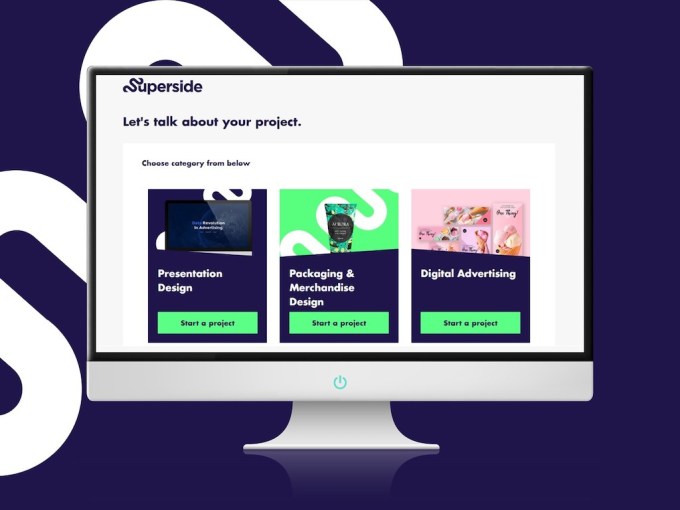
superside step1 orderwizard

Thomassen said the platform is built for large enterprises that have their own design and marketing teams but still need additional support. Customers include Uber, LinkedIn, L’Oreal, Cisco, Santander, Amazon, Walmart Tiffany & Co. Hewlett Packard and Airbus

In addition to choosing good designers, Superside also built a broader project management platform.

“We’re basically automating everything: Finding people, screening people, on-boarding, on-the-job learning, invoicing of customers, project management, all of the nitty gritty,” Thomassen said. “The only thing not automated is design — that’s where the human element and the creativity come in.”

Plus, Thomassen said Superside can turn around a standard piece of artwork in 12 hours: “Nobody else can do what we’re doing in terms of speed.”

The new funding comes from Freestyle Capital, with participation from High Alpha Ventures, Y Combinator and Alliance Ventures.

“We’re very much a mission-driven company,” Thomassen added. “For me, the reason to go to work in the morning is to help build an online labor market and create equal economic opportunity for everyone in the world.”


from TechCrunch https://ift.tt/32ALgwq
via IFTTT

miércoles, 4 de septiembre de 2019

Daily Crunch: Google reaches $170M settlement with FTC

The Daily Crunch is TechCrunch’s roundup of our biggest and most important stories. If you’d like to get this delivered to your inbox every day at around 9am Pacific, you can subscribe here.

1. Children’s privacy costs just $170 million for Google in settlement with the FTC

The complaint from the Federal Trade Commission and the New York Attorney General’s office focused on YouTube’s use of cookies to track viewers of kids’ channels without getting permission from parents. Under COPPA regulations, websites and online services targeting children need to disclose their data collection practices and receive consent from parents.

In addition to the payment — a relatively small sum for YouTube-owner Google — the settlement requires the company to develop a system that allows channel-owners to identify content aimed at children.

2. Amazon unveils a new Fire TV Cube, soundbar and over a dozen Fire TV Edition products

The new products include a next-generation Fire TV Cube, a Fire TV Edition soundbar from Anker — its first foray into Fire TV Edition audio products — and 15 other Fire TV Edition products, including the first OLED Fire TV Edition smart TVs.

3. Porsche unveils the $150,900 Taycan Turbo electric sedan

Porsche has poured more than $1 billion into the development of its first all-electric vehicle.

LOS ANGELES, CA – AUGUST 16: Actor Joseph Gordon-Levitt attends the 2014 Creative Arts Emmy Awards press room held at the Nokia Theatre L.A. Live on August 16, 2014 in Los Angeles, California. (Photo by Tommaso Boddi/WireImage)

4. Joseph Gordon-Levitt is coming to Disrupt SF 2019

Gordon-Levitt isn’t just the star of movies like “500 Days of Summer” — he’s also the founder of production company HitRecord, which he’s trying to turn into “GitHub for creativity.”

5. Ginger, an MIT spinout providing app-based mental health coaching to workers, raises $35M

Ginger works with companies and their healthcare providers to provide employees with an app-based way to connect with coaches to talk through their issues and suggest ways forward.

6. Mental health websites in Europe found sharing user data for ads

Europeans going online to seek support for these issues are having sensitive health data tracked and passed to third parties, according to Privacy International’s findings.

7. Light Phone’s founders discuss life beyond the smartphone

The company has run two successful crowdfunding campaigns for a pair of minimalist phones designed to augment or replace the smartphone. Today the startup announced that it will be shipping its second version of the handset. (Extra Crunch membership required.)


from TechCrunch https://ift.tt/2PLajeD
via IFTTT