lunes, 17 de agosto de 2020

Deepfake video app Reface is just getting started on shapeshifting selfie culture

A bearded Rihanna gyrates and sings about shining bright like a diamond. A female Jack Sparrow looks like she’d be a right laugh over a pint. The cartoon contours of The Incredible Hulk lend envious tint to Donald Trump’s awfully familiar cheek bumps.

Selfie culture has a fancy new digital looking glass: Reface (previously Doublicat) is an app that uses AI-powered deepfake technology to let users try on another face/form for size. Aka “face swap videos”, in its marketing parlance.

Deepfake technology — or synthesized media, to give it its less pejorative label — is just getting into its creative stride, according to Roman Mogylnyi, CEO and co-founder of RefaceAI, which makes the eponymous app whose creepily lifelike output you may have noticed bubbling up in your social streams in recent months.

The startup has Ukrainian founders — as well as Mogylnyi, there’s Oles Petriv, Yaroslav Boiko, Dima Shvets, Denis Dmitrenko, Ivan Altsybieiev and Kyle Sygyda — but the business is incorporated in the US. Doubtless it helps to be nearer to Hollywood studios whose video clips power many of the available face swaps. (Want to see Titanic‘s Rose Hall recast with Trump’s visage staring out of Kate Winslet’s body? No we didn’t either — but once you’ve hit the button it’s horribly hard to unsee… 馃樂)

TechCrunch noticed a bunch of male friends WhatsApp-group-sharing video clips of themselves as scantily clad female singers and figured the developers must be onto something — a la Face App, or the earlier selfie trend of style transfer (a craze that was sparked by Prisma and cloned mercilessly by tech giants).

Reface’s deepfake effects are powered by a class of machine learning frameworks known as GANs (generative adversarial network) which is how it’s able to get such relatively slick results, per Mogylnyi. In a nutshell it’s generating a new animated face using the twin inputs (the selfie and the target video), rather than trying to mask one on top of the other.

Deepface technology has of course been around for a number of years, at this point, but the Reface team’s focus is on making the tech accessible and easy to use — serving it up as a push-button smartphone app with no need for more powerful hardware and near instant transformation from a single selfie snap. (It says it turns selfies into face vectors representing distinguishing user’s facial features — and pledges that uploaded photos are removed from its Google Cloud platform “within an hour”.)

No need for tech expertise nor lots of effort to achieve a lifelike effect. The inexorable social shares flowing from such a user friendly tech application then work to chalk off product marketing.

It was a similar story with the AI tech underpinning Prisma — which left that app open to merciless cloning, though it was initially only transforming photos. But Mogylnyi believes the team behind the video face swaps has enough of a head (ha!) start to avoid a similar fate.

He says usage of Reface has been growing “really fast” since it added high res videos this June — having initially launched with only far grainier GIF face swaps on offer.  In terms of metrics the startup us not disclosing active monthly users but says it’s had around 20 million downloads at this point across 100 countries. (On Google Play the app has almost a full five star rating, off of approaching 150k reviews.)

“I understand that an interest from huge companies might come. And it’s obvious. They see that it’s a great thing — personalization is the next trend, and they are all moving in the same direction, with Bitmoji, Memoji, all that stuff — but we see personalized, hyperrealistic face swapping as the next big thing,” Mogylnyi tells TechCrunch.

“Even for [tech giants] it takes time to create such a technology. Even speaking about our team we have a brilliant team, brilliant minds, and it took us a long time to get here. Even if you spawn many teams to work on the same problems surely you will get somewhere… but currently we’re ahead and we’re doing our best to work on new technologies to keep in pace,” he adds.

Reface’s app is certainly having a moment right now, bagging top download slots on the iOS App Store and Google Play in 100 countries — helped, along the way, by its reflective effects catching the eye of the likes of Elon Musk and Britney Spears (who Mogylnyi says have retweeted examples of its content).

But he sees this bump as just the beginning — predicting much bigger things coming down the sythensized pipe as more powerful features are switched on. The influx of bitesized celebrity face swaps signals an incoming era of personalized media, which could have a profoundly transformative effect on culture.

Mogylnyi’s hope is that wide access to synthensized media tools will increase humanity’s empathy and creativity — providing those who engage with the tech limitless chances to (auto)vicariously experience things they maybe otherwise couldn’t ever (or haven’t yet) — and so imagine themselves into new possibilities and lifestyles.

He reckons the tech will also open up opportunities for richly personalized content communities to grow up around stars and influencers — extending how their fans can interact with them.

“Right now the way influencers exist is only one way; they’re just giving their audience the content. In my understanding in our case we’ll let influencers have the possibility to give their audience access to the content and to feel themselves in it. It’s one of the really cool things we’re working on — so it will be a part of the platform,” he says.

“What’s interesting about new-gen social networks [like TikTok] is that people can both be like consumers and providers at the same time… So in our case people will also be able to be providers and consumers but on the next level because they will have the technology to allow themselves to feel themselves in the content.”

“I used to play basketball in school years but I had an injury and I was dreaming about a pro career but I had to stop playing really hard. I’ll never know how my life would have gone if I was a pro basketball player so I have to be a startup entrepreneur right now instead… So in the case with our platform I actually will have a chance to see how my pro basketball career would look like. Feel myself in the content and life this life,” he adds.

This vision is really the mirror opposite of the concerns that are typically attached to deepfakes, around the risk of people being taken in, tricked, shamed or otherwise manipulated by intentionally false imagery.

So it’s noteworthy that Reface is not letting users loose on their technology in a way that could risk an outpouring of problem content. For example, you can’t yet upload your own video to make into a deepfake — although the ability to do so is coming. For now, you have to pick from a selection of preloaded celebrity clips and GIFs which no one would mistake for the real-deal.

That’s a very deliberate decision, with Mogylnyi emphasizing they want to be responsible in how they bring the tech to market.

User generated video and a lot more — full body swaps are touted, next year — are coming, though. But before they turn on more powerful content generation functionality they’re working on building a counter tech to reliably detect such generated content. Mogylnyi says it will only open up usage once they’re confident of being able to spot their own fakes.

“It will be this autumn, actually,” he says of launching UGC video (plus the deepfake detection capability). “We’ll launch it with our Face Studio… which will be a tool for content creators, for small studios, for small post production studios, maybe some music video makers.”

“We also have five different technologies in our pipeline which we’ll show in the upcoming half a year,” he adds. “There are also other technologies and features based on current tech [stack] that we’ll be launching… We’ll allow users to swap faces in pictures with the new stack and also a couple of mechanics based on face swapping as well, and also separate technologies as well we’re aiming to put into the app.”

He says higher quality video swapping is another focus, alongside building out more technologies for post production studios. “Face Studio will be like an overall tool for people who want full access to our technologies,” he notes, saying the pro tool will launch later this year.

The Ukrainian team behind the app has been honing their deep tech chops for years — starting working together back in 2011 straight out of university and going on to set up a machine learning dev shop in 2013.

Work with post production studios followed, as they were asked to build face swapping technology to help budget-strapped film production studios do more while having to move their actors move around less.

By 2018, with plenty of expertise under their belt, they saw the potential for making deepface technology more accessible and user friendly — launching the GIF version of the app late last year, and going on to add video this summer when they also rebranded the app to Reface. The rest looks like it could be viral face swapping tech history…

So where does all this digital shapeshifting end up? “In our dreams and in our vision we see the app as a personalization platform where people will be able to live different lives during their one lifetime. So everyone can be anyone,” says Mogylnyi. “What’s the overall problem right now? People are scrolling content, not looking deep into it. And when I see people just using our app they always try to look inside — to look deeply into the picture. And that’s what really inspires us. So we understand that we can take the way people are browsing and the way they are consuming content to the next level.”


from TechCrunch https://ift.tt/2YbX48x
via IFTTT

lunes, 10 de agosto de 2020

With a renewed focus on creative skills, online learning company Skillshare raises $66M

Skillshare CEO Matt Cooper said 2020 has been a year of rapid growth — even before the pandemic forced large swaths of the population to stay home and turn to online learning for entertainment and enrich.

Cooper (who became CEO in 2017) told me that the company decided last year to “focus on our strength,” leading to a “brand relaunch” in January 2020 to emphasize the richness of its creativity-themed content. At the same time, Cooper said the company defines creativity very broadly, with classes divided into categories like animation, design, illustration, photography, filmmaking and writing.

“It’s not Bob Ross,” he said. “And I love Bob Ross, but that’s a very narrow definition of creativity. Creativity can come in lots of different forms — art, design, journaling, creative writing it can be culinary, it can be crafts.”

Cooper added that daily usage was already up significantly by mid-March, when the pandemic led to widespread social distancing orders across the United States. That created some challenges, particularly for the more polished Skillshare Originals that the company offers alongside its user-generated classes. (For example, Originals include a color masterclass taught by Victo Ngai, a class on “discovering your creative voice” taught by Shantell Martin and a creative nonfiction class by Susan Orlean.)

But of course the pandemic also meant that, as Cooper put it, “A lot more people had a lot more free time at home and were looking for a constructive way to spend it.” In fact, the company said that since its rebranding, new membership sign-ups have tripled, with existing members watching three times the number of lessons.

And Skillshare has continued producing Originals by sending instructors “a huge box of gear” and then supervising the shoot remotely. In fact, Cooper suggested that this has “opened up a whole new world” for the Originals team, allowing them to “look at parts of the world where we probably weren’t going to fly a camera crew to go shoot.”

The company now has 12 million registered members, 8,000 teachers and 30,000 classes — all accessible for $99 a year or $19 a month. And it’s announcing that it has raised $66 million in new funding led by OMERS Growth Equity, with managing director Saar Pikar joining the board of directors. Previous investors Union Square Ventures, Amasia Ventures, Burda Principal Investments and Spero Ventures also participated.

“Skillshare serves the needs of professional creatives and everyday creative hobbyists alike, which presents a highly-innovative value proposition for the online learning market,” Pikar said in a statement. “We look forward to deepening our partnership with Skillshare, and our fellow investors, in order to help Matt Cooper and his team scale up the company’s international reach – and help Skillshare achieve the full potential of its unique approach to online learning.”

Cooper added that the company (which had previously raised $42 million) was cashflow positive for the first half of 2020, so it raised the new round to invest in growth — particularly in the Skillshare for Teams enterprise product, which allows customers like GM Financial, Vice, AWS, Lululemon, American Crafts and Benefit to offer Skillshare as a perk for their employees.

Cooper i also hoping to expand internationally. Apparently two-thirds of new member sign-ups are coming from outside the United States, with India as Skillshare’s fastest growing market, and that’s with “no local language content, no local language teachers.” While Cooper plans to remain focused on English content for the near future, he noted that there are other steps Skillshare can take to encourage global viewership, like accepting payments in different currencies and supporting subtitles in different languages.

“Just by making it a little easier for those international users to get value from the platform, we expect to see dramatic growth in these international markets,” he said.


from TechCrunch https://ift.tt/3kvIke3
via IFTTT

viernes, 7 de agosto de 2020

Hypotenuse AI wants to take the strain out of copywriting for ecommerce

Imagine buying a dress online because a piece of code sold you on its ‘flattering, feminine flair’ — or convinced you ‘romantic floral details’ would outline your figure with ‘timeless style’. The very same day your friend buy the same dress from the same website but she’s sold on a description of ‘vibrant tones’, ‘fresh cotton feel’ and ‘statement sleeves’.

This is not a detail from a sci-fi short story but the reality and big picture vision of Hypotenuse AI, a YC-backed startup that’s using computer vision and machine learning to automate product descriptions for ecommerce.

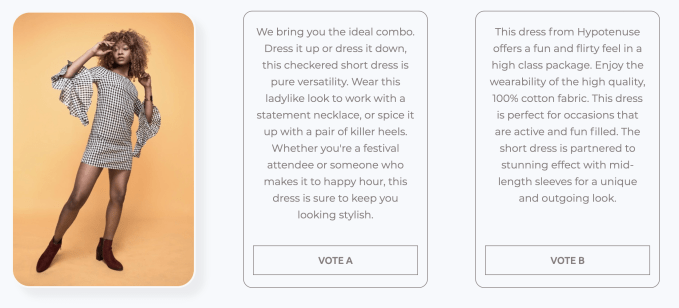
One of the two product descriptions shown below is written by a human copywriter. The other flowed from the virtual pen of the startup’s AI, per an example on its website.

Can you guess which is which?* And if you think you can — well, does it matter?

Screengrab: Hypotenuse AI’s website

Discussing his startup on the phone from Singapore, Hypotenuse AI’s founder Joshua Wong tells us he came up with the idea to use AI to automate copywriting after helping a friend set up a website selling vegan soap.

“It took forever to write effective copy. We were extremely frustrated with the process when all we wanted to do was to sell products,” he explains. “But we knew how much description and copy affect conversions and SEO so we couldn’t abandon it.”

Wong had been working for Amazon, as an applied machine learning scientist for its Alexa AI assistant. So he had the technical smarts to tackle the problem himself. “I decided to use my background in machine learning to kind of automate this process. And I wanted to make sure I could help other ecommerce stores do the same as well,” he says, going on to leave his job at Amazon in June to go full time on Hypotenuse.

The core tech here — computer vision and natural language generation — is extremely cutting edge, per Wong.

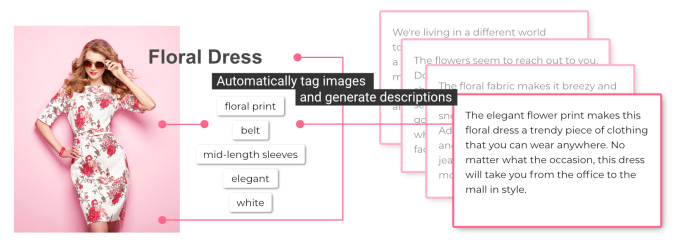
“What the technology looks like in the backend is that a lot of it is proprietary,” he says. “We use computer vision to understand product images really well. And we use this together with any metadata that the product already has to generate a very ‘human fluent’ type of description. We can do this really quickly — we can generate thousands of them within seconds.”

“A lot of the work went into making sure we had machine learning models or neural network models that could speak very fluently in a very human-like manner. For that we have models that have kind of learnt how to understand and to write English really, really well. They’ve been trained on the Internet and all over the web so they understand language very well. “Then we combine that together with our vision models so that we can generate very fluent description,” he adds.

Image credit: Hypotenuse

Wong says the startup is building its own proprietary data-set to further help with training language models — with the aim of being able to generate something that’s “very specific to the image” but also “specific to the company’s brand and writing style” so the output can be hyper tailored to the customer’s needs.

“We also have defaults of style — if they want text to be more narrative, or poetic, or luxurious —  but the more interesting one is when companies want it to be tailored to their own type of branding of writing and style,” he adds. “They usually provide us with some examples of descriptions that they already have… and we used that and get our models to learn that type of language so it can write in that manner.”

What Hypotenuse’s AI is able to do — generate thousands of specifically detailed, appropriately styled product descriptions within “seconds” — has only been possible in very recent years, per Wong. Though he won’t be drawn into laying out more architectural details, beyond saying the tech is “completely neural network-based, natural language generation model”.

“The product descriptions that we are doing now — the techniques, the data and the way that we’re doing it — these techniques were not around just like over a year ago,” he claims. “A lot of the companies that tried to do this over a year ago always used pre-written templates. Because, back then, when we tried to use neural network models or purely machine learning models they can go off course very quickly or they’re not very good at producing language which is almost indistinguishable from human.

“Whereas now… we see that people cannot even tell which was written by AI and which by human. And that wouldn’t have been the case a year ago.”

(See the above example again. Is A or B the robotic pen? The Answer is at the foot of this post)

Asked about competitors, Wong again draws a distinction between Hypotenuse’s ‘pure’ machine learning approach and others who relied on using templates “to tackle this problem of copywriting or product descriptions”.

“They’ve always used some form of templates or just joining together synonyms. And the problem is it’s still very tedious to write templates. It makes the descriptions sound very unnatural or repetitive. And instead of helping conversions that actually hurts conversions and SEO,” he argues. “Whereas for us we use a completely machine learning based model which has learnt how to understand language and produce text very fluently, to a human level.”

There are now some pretty high profile applications of AI that enable you to generate similar text to your input data — but Wong contends they’re just not specific enough for a copywriting business purpose to represent a competitive threat to what he’s building with Hypotenuse.

“A lot of these are still very generalized,” he argues. “They’re really great at doing a lot of things okay but for copywriting it’s actually quite a nuanced space in that people want very specific things — it has to be specific to the brand, it has to be specific to the style of writing. Otherwise it doesn’t make sense. It hurts conversions. It hurts SEO. So… we don’t worry much about competitors. We spent a lot of time and research into getting these nuances and details right so we’re able to produce things that are exactly what customers want.”

So what types of products doesn’t Hypotenuse’s AI work well for? Wong says it’s a bit less relevant for certain product categories — such as electronics. This is because the marketing focus there is on specs, rather than trying to evoke a mood or feeling to seal a sale. Beyond that he argues the tool has broad relevance for ecommerce. “What we’re targeting it more at is things like furniture, things like fashion, apparel, things where you want to create a feeling in a user so they are convinced of why this product can help them,” he adds.

The startup’s SaaS offering as it is now — targeted at automating product description for ecommerce sites and for copywriting shops — is actually a reconfiguration itself.

The initial idea was to build a “digital personal shopper” to personalize the ecommerce experence. But the team realized they were getting ahead of themselves. “We only started focusing on this two weeks ago — but we’ve already started working with a number of ecommerce companies as well as piloting with a few copywriting companies,” says Wong, discussing this initial pivot.

Building a digital personal shopper is still on the roadmap but he says they realized that a subset of creating all the necessary AI/CV components for the more complex ‘digital shopper’ proposition was solving the copywriting issue. Hence dialling back to focus in on that.

“We realized that this alone was really such a huge pain-point that we really just wanted to focus on it and make sure we solve it really well for our customers,” he adds.

For early adopter customers the process right now involves a little light onboarding — typically a call to chat through their workflow is like and writing style so Hypotenuse can prep its models. Wong says the training process then takes “a few days”. After which they plug in to it as software as a service.

Customers upload product images to Hypotenuse’s platform or send metadata of existing products — getting corresponding descriptions back for download. The plan is to offer a more polished pipeline process for this in the future — such as by integrating with ecommerce platforms like Shopify.

Given the chaotic sprawl of Amazon’s marketplace, where product descriptions can vary wildly from extensively detailed screeds to the hyper sparse and/or cryptic, there could be a sizeable opportunity to sell automated product descriptions back to Wong’s former employer. And maybe even bag some strategic investment before then…  However Wong won’t be drawn on whether or not Hypotenuse is fundraising right now.

On the possibility of bagging Amazon as a future customer he’ll only say “potentially in the long run that’s possible”.

Joshua Wong (Photo credit: Hypotenuse AI)

The more immediate priorities for the startup are expanding the range of copywriting its AI can offer — to include additional formats such as advertising copy and even some ‘listicle’ style blog posts which can stand in as content marketing (unsophisticated stuff, along the lines of ’10 things you can do at the beach’, per Wong, or ’10 great dresses for summer’ etc).

“Even as we want to go into blog posts we’re still completely focused on the ecommerce space,” he adds. “We won’t go out to news articles or anything like that. We think that that is still something that cannot be fully automated yet.”

Looking further ahead he dangles the possibility of the AI enabling infinitely customizable marketing copy — meaning a website could parse a visitor’s data footprint and generate dynamic product descriptions intended to appeal to that particular individual.

Crunch enough user data and maybe it could spot that a site visitor has a preference for vivid colors and like to wear large hats — ergo, it could dial up relevant elements in product descriptions to better mesh with that person’s tastes.

“We want to make the whole process of starting an ecommerce website super simple. So it’s not just copywriting as well — but all the difference aspects of it,” Wong goes on. “The key thing is we want to go towards personalization. Right now ecommerce customers are all seeing the same standard written content. One of the challenges there it’s hard because humans are writing it right now and you can only produce one type of copy — and if you want to test it for other kinds of users you need to write another one.

“Whereas for us if we can do this process really well, and we are automating it, we can produce thousands of different kinds of description and copy for a website and every customer could see something different.”

It’s a disruptive vision for ecommerce (call it ‘A/B testing’ on steroids) that is likely to either delight or terrify — depending on your view of current levels of platform personalization around content. That process can wrap users in particular bubbles of perspective — and some argue such filtering has impacted culture and politics by having a corrosive impact on the communal experiences and consensus which underpins the social contract. But the stakes with ecommerce copy aren’t likely to be so high.

Still, once marketing text/copy no longer has a unit-specific production cost attached to it — and assuming ecommerce sites have access to enough user data in order to program tailored product descriptions — there’s no real limit to the ways in which robotically generated words could be reconfigured in the pursuit of a quick sale.

“Even within a brand there is actually a factor we can tweak which is how creative our model is,” says Wong, when asked if there’s any risk of the robot’s copy ending up feeling formulaic. “Some of our brands have like 50 polo shirts and all of them are almost exactly the same, other than maybe slight differences in the color. We are able to produce very unique and very different types of descriptions for each of them when we cue up the creativity of our model.”

“In a way it’s sometimes even better than a human because humans tends to fall into very, very similar ways of writing. Whereas this — because it’s learnt so much language over the web — it has a much wider range of tones and types of language that it can run through,” he adds.

What about copywriting and ad creative jobs? Isn’t Hypotenuse taking an axe to the very copywriting agencies his startup is hoping to woo as customers? Not so, argues Wong. “At the end of the day there are still editors. The AI helps them get to 95% of the way there. It helps them spark creativity when you produce the description but that last step of making sure it is something that exactly the customer wants — that’s usually still a final editor check,” he says, advocating for the human in the AI loop. “It only helps to make things much faster for them. But we still make sure there’s that last step of a human checking before they send it off.”

“Seeing the way NLP [natural language processing] research has changed over the past few years it feels like we’re really at an inception point,” Wong adds. “One year ago a lot of the things that we are doing now was not even possible. And some of the things that we see are becoming possible today — we didn’t expect it for one or two years’ time. So I think it could be, within the next few years, where we have models that are not just able to write language very well but you can almost speak to it and give it some information and it can generate these things on the go.”

*Per Wong, Hypotenuse’s robot is responsible for generating description ‘A’. Full marks if you could spot the AI’s tonal pitfalls


from TechCrunch https://ift.tt/3kn9G63
via IFTTT

domingo, 19 de julio de 2020

The dual PhD problem of today’s startups

One of the upsides of this job is that you get to see everything going on out there in the startup world. One of the downsides of this job is seeing just how many ideas out there aren’t all that original.

Every week in my inbox, there is another no-code startup. Another fintech play for payments and credit cards and personal finance. Another remote work or online events startup. Another cannabis startup, another cryptocurrency, another analytics tool for some other function in the workplace (janitor productivity as a service!)

It honestly feels at times like we are stuck: it’s the same rehashes of old software, but theoretically “better” (yes it is a note-taking app, but it runs on Kubernetes!). In fact, that feeling of repetitiveness and the glacial pace of true innovation isn’t just in my head or maybe yours: it’s also been identified by scientists and researchers and remains a key area of debate in the economics of innovation field.

Of course, there are a bunch of new horizons out there. Synthetic biology and personalized medicine. Satellites and spacetech. Cryptocurrencies and finance. Autonomous vehicles and urbantech. Open semiconductor platforms and the future of silicon. In fact, there are so many open vistas that it surprises me that every entrepreneur and investor isn’t running to claim these new territories ripe for creativity and ultimately, profit.

It’s a quandary at least until you begin to understand the entrance requirements for these frontier fields.

We’ve gone through the generation of startups you can do as a dropout from high school or college, hacking a social network out of PHP scripts or assembling a computer out of parts at a local homebrew club. We’ve also gone through the startups that required a PhD in electrical engineering, or biology, or any of the other science and engineering fields that are the wellspring for innovation.

Now, we are approaching a new barrier — ideas that require not just extreme depth in one field, but depth in two or sometimes even more fields simultaneously.

Take synethtic biology and the future of pharmaceuticals. There is a popular and now well-funded thesis on crossing machine learning and biology/medicine together to create the next generation of pharma and clinical treatment. The datasets are there, the patients are ready to buy, and the old ways of discovering new candidates to treat diseases look positively ancient against a more deliberate and automated approach afforded by modern algorithms.

Moving the needle even slightly here though requires enormous knowledge of two very hard and disparate fields. AI and bio are domains that get extremely complex extremely fast, and also where researchers and founders quickly reach the frontiers of knowledge. These aren’t “solved” fields by any stretch of the imagination, and it isn’t uncommon to quickly reach a “No one really knows” answer to a question.

It’s what you might call the dual PhD problem of today’s startups. To be clear, this isn’t about credentials — it’s not about the sheepskin at the end of the grad program. It’s about the knowledge represented by that diploma and how you need two whole rounds of it in order to synthesize the next generation of solutions.

Now, before you start yelling, let’s talk about teams. There is a reasonable argument that teams with the right specializations can come together and solve these problems. You don’t need a single founder with experience in bio and AI or cryptography and economics or computer vision and mobility hardware — you just need to bring the right talents together in the room to make innovation happen.

There is certainty truth in that, and indeed, that’s the impetus for many of the companies we are seeing today in these fields.

But that also feels like precisely the block today for pushing innovation even farther forward. Today’s startups have a biologist talking about wet labs on one side and an AI specialist waxing on about GPT-3 on the other, or a cryptography expert negotiating their point of view with a securities attorney. There is constant and serious translation required between these domains, translation that (I would argue mostly) prevents the fusion these fields need in order for new startups to be built.

Perhaps there is no greater and more obvious example of these domain requirements than the response to COVID-19. Epidemiology and public health are quite possibly the two most difficult fields out there in terms of the number of specializations required simultaneously to do them well. You need to know medicine and human physiology to understand the etiology of diseases, have the social science background to understand how humans interact individually and in groups, understand the economic and public policy implications of different prophylactics to comprehend the trade-offs involved, and finally, master the statistical training to read, understand, and build correct data models.

All this, and all at the same time. Is it any wonder that so little consensus emerges when so few people have all the requisite skills in their head?

The reason that teams run into resistance is that each specialist needs to understand the constraints that all the other specialties have, while also having enough nuance to understand what is really a barrier and what is perhaps a rule that can be broken. You can’t have a non-technical PM manage an AI product (“Can’t we just use TensorFlow for that?”) anymore than you can have these companies built by incompatible experts, always trying to explain to the other why an idea isn’t fathomable.

We aren’t used to this sort of cognitive challenge. Software is so democratized today, we forget just how blisteringly difficult almost all other facets of human endeavor are to even start. A middle schooler can build and deploy a web service scalable to millions of people with some lines of code (learned from easily and widely accessible resources on the internet) and some basic cloud infrastructure tools that are designed to onboard new users expeditiously.

Try that with rocketry. Or with pharma. Or with autonomous vehicles. Or any of the interesting new frontiers with green fields that are just sitting there waiting for the taking.

So to propel the progress of the world further, we need to fuse more fields together and compress the requisite knowledge faster and earlier for more people. We can’t wait until 25 years of school is complete and people graduate haggard at 40 before they can take a shot at some of these fascinating intersections. We need to build slipstreams to these lacuna where innovation hasn’t yet reached.

Otherwise, we are going to see the same pattern in the future that we see today: the thirtieth app for X with no barrier to entry whatsoever. That’s not where progress comes.


from TechCrunch https://ift.tt/39iX1fu
via IFTTT

jueves, 16 de julio de 2020

Instagram confirms its TikTok rival, Reels, will launch in the US in early August

Instagram confirmed it’s preparing to soon launch its TikTok competitor, known as Reels, in the U.S. The company expects to bring the new video feature — which is designed specifically for short-form, creative content — to its platform in early August, according to a spokesperson. The U.S. launch comes shortly after Reels’ arrival in India this month, following a ban of TikTok in that market. Reels has also been tested in Brazil, France, and Germany.

NBC News reported this morning Instagram would arrive in the U.S. and more than 50 other countries in a matter of weeks, citing sources familiar with the matter.

A Facebook spokesperson confirmed the U.S. launch, saying “We’re excited to bring Reels to more countries, including the U.S., in early August,” without providing specific details of which further markets will be added.

“The community in our test countries has shown so much creativity in short-form video, and we’ve heard from creators and people around the world that they’re eager to get started as well,” the spokesperson added.

Reels was designed to directly challenge TikTok’s growing dominance. In a new area in the app, users are able to create and post short, 15-second videos set to music or other audio, similar to TikTok. Also like TikTok, Reels offers a set of editing tools — like a countdown timer and tools to adjust the video’s speed, for example — that aim to make it easier to record creative content. Instagram, of course, doesn’t have the same sort of two-tabbed, scrollable feed, like TikTok offers today.

The move to more quickly roll out Reels to more markets comes as TikTok has come under intense scrutiny for its ties to China. India banned the app, along with 58 other mobile applications designed by Chinese firms, in June. The Trump administration more recently said it was considering a similar ban on TikTok, for reasons related to national security. Yesterday, it said such a decision could be just weeks away.

Since the news of a possible ban hit, other TikTok rivals got a boost in the charts, including Byte, Triller, Dubsmash, and Likee, for example. Snapchat also began testing a TikTok-like navigation for its public video content, and YouTube is running a smaller test. Because of Instagram’s reach, it has a shot at stepping in to pick up tens of millions of U.S. users if TikTok disappears. But TikTok users may not jump en masse to a single new app if a ban occurs. Already there are signs of the community splintering — dancers prefer apps like Dubsmash and Triller, while young Gen Z’ers like Byte, for example.

No exact launch date for Instagram Reels in the U.S. was provided.


from TechCrunch https://ift.tt/3ezLycg
via IFTTT

mi茅rcoles, 15 de julio de 2020

Amazon Influencer Program opens to livestreamers for broadcasting to Amazon Live

Amazon is giving livestreamers a new way to earn commissions on purchases of products showcased in their streams. The company is today adding livestreaming to its existing Amazon Influencer Program which before today, allowed social media influencers to earn money by pointing fans to their favorite Amazon products through posts on Facebook, Twitter, Instagram and YouTube.

The Influencer Program quietly debuted in 2017 as a way for Amazon to capitalize on the growing trend of influencer marketing as a way to drive sales. The program itself is a step up from the Amazon Associates program, as it requires approval to join and gives influencers their own page with an Amazon URL to showcase their recommendations.

Though Amazon already catered to video creators through the program, the new livestreaming option is focused on its own Amazon Live service. A sort of modern-day version of QVC that streams directly on Amazon’s shopping site, Amazon Live launched last year as the retailer’s latest effort to attract consumers by way of live video.

On Amazon Live shows, hosts talk about and demonstrate products, much like they would do on home shopping networks. Underneath the video, a carousel guides consumers purchase the items featured.

This service wasn’t Amazon’s first attempt at live content — the retailer pulled the plug on its earlier effort in live content, a short-lived “show” called Style Code Live that featured hosts with TV and broadcast backgrounds who brought in experts to talk beauty and style tips.

Amazon Live, however, isn’t narrowly focused on fashion and beauty. Instead, its content can cover a range of categories — like cooking, fitness, baby, home, auto, electronics, toys, pets, moves and TV, industrial and much more. There are also multiple live channels to flip through, unlike on cable TV shopping networks.

To broadcast to Amazon Live, video creators and now, influencers use the Amazon Live Creator app to livestream and chat with viewers as they show off the products to be shopped. On the Amazon Live homepage, fans can also chat with the host and one another in a Twitch-like side panel next to the live video.

You can see a few influencers’ streams in action, with early adopters Mirror & Thread, Beauty by Carla, The Deal Guy, and BrickinNick already available on Amazon Live.

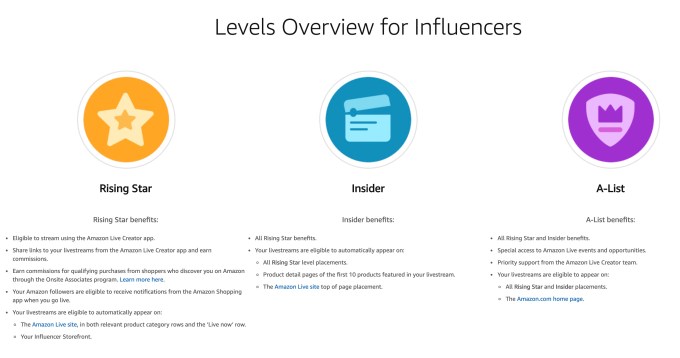
In addition, influencers who livestream on Amazon Live as a part of the new program will have their videos not only streamed on the Amazon Live homepage itself, but also on their own dedicated Amazon storefront. As they grow their fanbase, they can move up levels from “Rising Star” to “Insider” to “A-List.”

Image Credits: Amazon

These tiers have various rewards and features. Rising Star, for example, offers paid commission on qualifying purchases through Amazon’s Onsite Associates program, while higher levels get to have their videos showcased on product detail pages in addition to their own storefront and Amazon Live. A-List’ers also receive priority support and special access to Amazon Live events and opportunities, says Amazon.

“We’re focused on bringing customers fun and interactive shopping experiences, while also helping influencers grow their businesses on Amazon,” said Amazon Live Director, Munira Rahemtulla, in a statement. “Livestreaming enables creativity, connection, and inspiration, and the opportunities are endless – we’re excited to introduce the Amazon Live Creator app to influencers and can’t wait to see what they’ll create for Amazon customers,” she added.

TechCrunch asked Amazon to clarify how influencers are compensated for their streams, given that today’s social media personalities have a number of way to work with brands for profit — including through YouTube BrandConnect, Facebook’s Brand Collaborations, and other programs, for example. The company has so far declined to provide further context, but we’ll update if that changes.


from TechCrunch https://ift.tt/38Y2fgt
via IFTTT

viernes, 10 de julio de 2020

COVID-19 pivot: Travel unicorn Klook sees jump in staycations

Spring 2020 was gloomy for Klook. As countries closed their borders and went into complete or partial lockdown, the SoftBank-backed travel platform saw its revenue plummet by as much as 90% through March and April. The World Travel and Tourism Council said in April that the coronavirus could put up to 100 million jobs in the global travel and tourism at risk.

But in the dark times, opportunities were also bubbling up.

Six-year-old Klook enables travelers, primarily from Asia, to discover and book overseas experiences ranging from Napa Valley wine tastings to staying with a farming family in Cambodia — a bit like Airbnb Experiences. It then takes a cut from each transaction that happens between the customer and activity vendor.

Before COVID-19, the startup, which crossed the $1 billion valuation mark back in 2018, was seeing 30 million monthly user sessions a month; by April, the figure shrank to 5 million. The constraints on people’s movement across the world, which is the foundation of its business, forced Klook to quickly rethink product offerings.

“At the end of the day, we are in the business of fun things to do. There are things to do at home, as well as local things to do when people could travel,” co-founder and chief operating officer Eric Gnock Fah told TechCrunch over a phone interview. “Now [the pandemic] is giving us an opportunity to add a new aspect to it.”

Staycation

Cooped up at home, people around the world turned to cooking, handcraft and other domestic projects as an outlet for entertainment and creativity. Klook responded to the demand by offering do-it-yourself kits for making bubble tea, macarons, candles and more — and delivering the material to people’s doorsteps. For people who were still eager to see the world, Klook partnered with landmark sites worldwide on online virtual tours, amassing close to 660,000 views in its first two livestreamed experiences.


from TechCrunch https://ift.tt/2AKWqWW
via IFTTT